
stroydom.ge
Updated:
What does it cost to build a 240 m² house in Tbilisi when the plot is on a slope? This is a worked example at our rates; the house and the plot in it are hypothetical. On a flat plot such a full-cycle house costs 300,000–372,000 GEL within the 1,250–1,550 GEL/m² range. Groundworks on a slope add 15–40% to the estimate, so the benchmark for a plot with a 3.2 m level difference is about 345,000–521,000 GEL. Below we break down where the money goes, why the level difference is better turned into a basement floor, and what the budget does not cover.
What plot and what house are in the example?
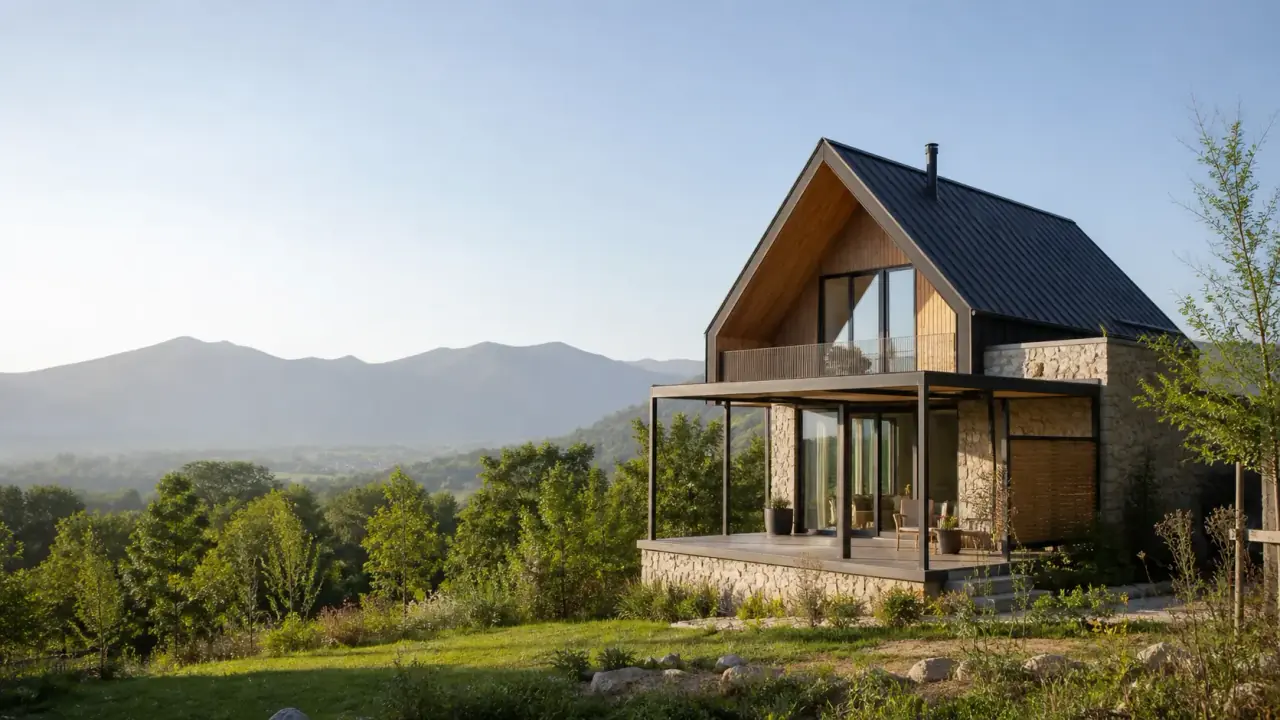
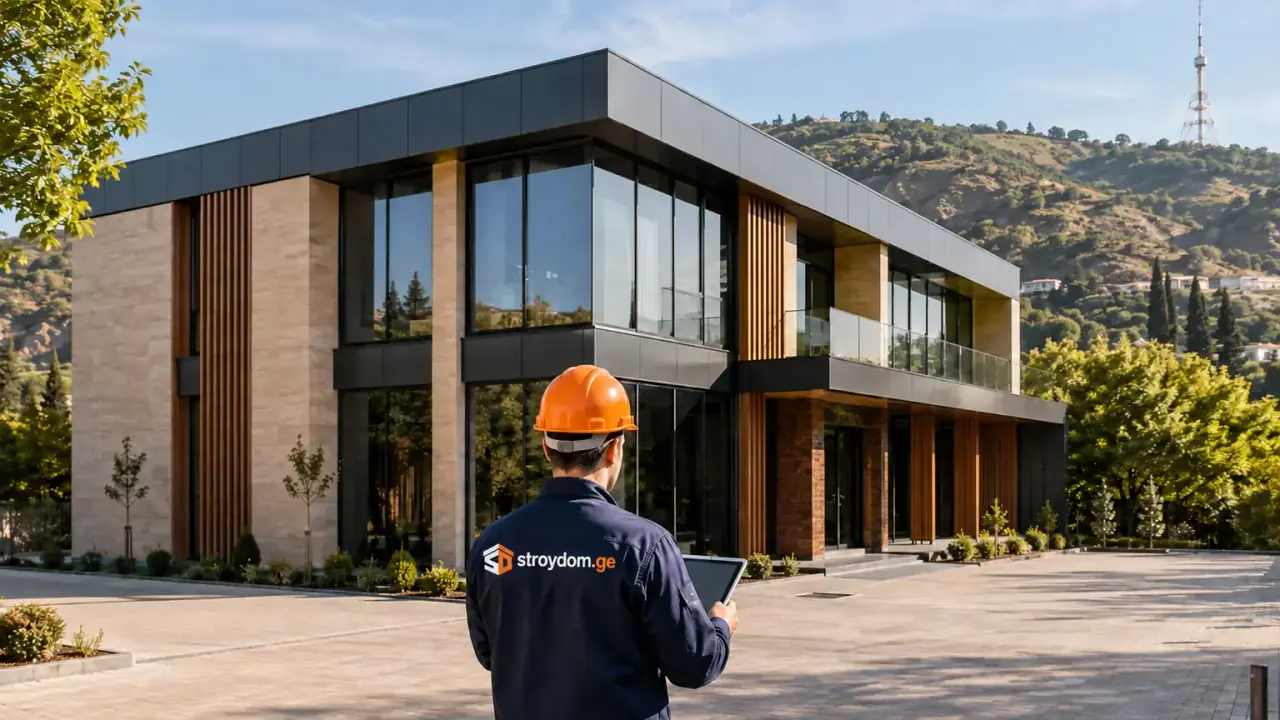
The plot is in Tbilisi on a south-facing slope with a 3.2 m level difference across the building footprint. The house is a two-storey monolithic concrete house of 240 m² with underfloor heating and a terrace facing the slope, full turnkey cycle under one contract. A garage and a plant room are needed, but the client does not want to give up living space for them.
On a flat plot this house is a standard job within our full-cycle construction service. A 3.2 m drop changes everything in the groundworks: the volume of excavation, the foundation design, the way water is handled. That is where the gap with a flat plot comes from, not the finishes.
What is the budget made of?
We fix the estimate in the contract in GEL by stage. Below is the scope for such a house. Exact line items appear after the geology and the design.
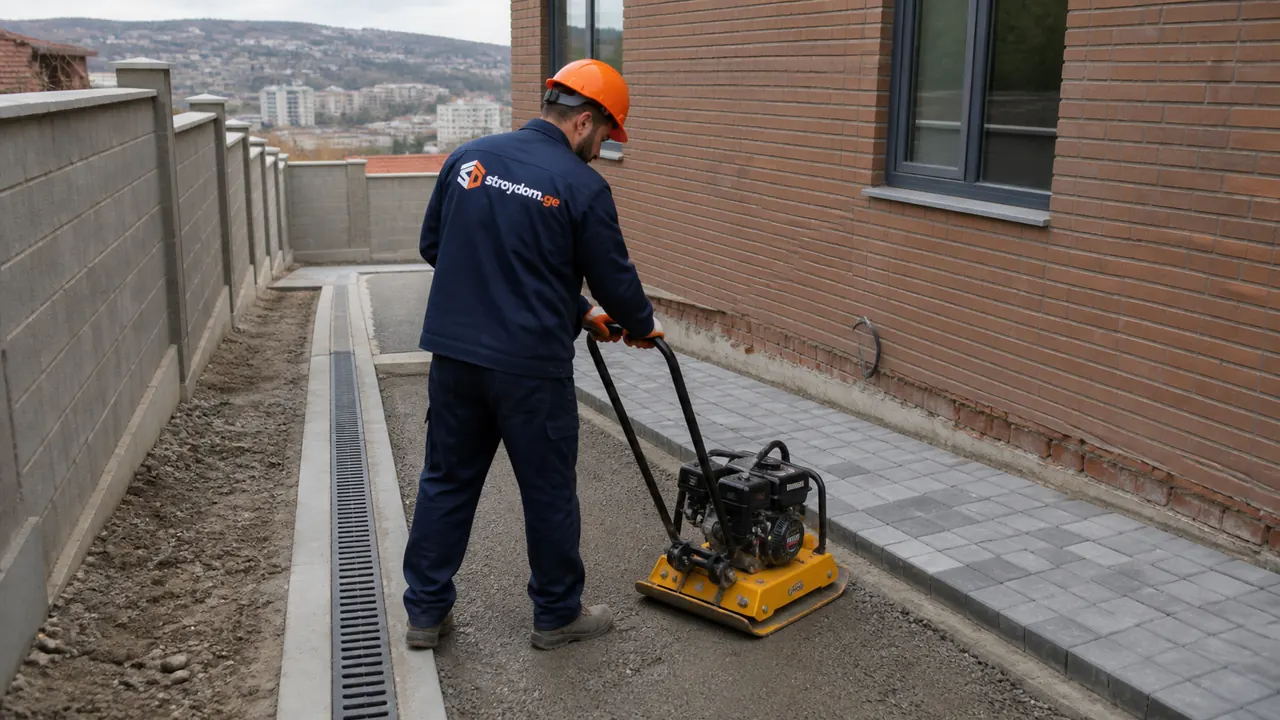
- Groundworks: excavation into the slope, monolithic foundation and basement walls, waterproofing and perimeter drainage. The most expensive stage on a slope: together with soil retention it reaches 25–35% of the estimate.
- Monolithic reinforced-concrete frame and slabs for two floors.
- Wall infill in 30 cm pumice block, about 380 m², with ring beams.
- Metal-tile roof, about 145 m², insulated with gutters, plus windows and external doors.
- Services: electrics, water supply, sewerage, heating, underfloor heating on 120 m² of the ground floor.
- Mid-level final finishes, internal doors, facade.
- Terrace towards the slope and minimal landscaping next to the house.
- Warranty under the contract: 10 years on the structure, 5 years on roofing and facade, 3 years on engineering, 2 years on finishes.
For comparison: in our costed budget for a 250 m² house on a flat plot the groundworks take 12–13% of the budget; on a slope they take two to three times as much. Add underfloor heating across the whole ground floor instead of radiators, and those two decisions do the most to set this budget apart from a house on a flat plot.
Why a basement rather than levelling the site?
The first option usually proposed on a slope is to level the site with fill and put the house on a strip foundation. With a 3.2 m drop that is a poor solution for three reasons.
- Fill that is not compacted layer by layer settles unevenly, which is worse than the natural slope. A foundation on it has to be designed as if on weak ground.
- You need a retaining wall close to 3 m high along the lower edge of the platform. High retaining walls of 2–4 m cost 1,600–3,200 GEL per linear metre, money that goes into the ground without giving you any floor area.
- Hauling soil in or out of a city plot is its own logistics problem, with restricted working hours for heavy machinery.
In the example the house stands on a basement floor: its walls act both as the foundation and as the retaining structure, designed in a single calculation. The garage and the plant room with the boiler and manifolds fit into the basement without taking any of the living area on the two floors above. The basement walls are monolithic concrete with bituminous waterproofing and wall drainage; stormwater run-off from the slope is designed as part of the foundation, not left to the landscaping stage. A stepped foundation on a slope normally adds 15–30% to the base price of the foundation type. Here that premium becomes a usable floor.
How long does the build take?
If the geology and design are ready before work starts on site, such a house can be built in 9 months. An indicative schedule by stage:
- Months 1–3: groundworks (excavation into the slope, drainage, reinforcement and pouring of the foundation and basement walls, curing time). Groundworks on a slope take 2–4 months; in the example, three.
- Months 3–5: monolithic frame with columns, beams, ground- and first-floor slabs and curing breaks.
- Months 5–6: pumice-block walls, ring beams, roof structure and metal tile. The house is weathertight.
- Months 6–7: windows, first-fix electrics and plumbing, underfloor heating, screed, plaster.
- Months 7–9: final finishes, facade, doors, heating commissioning and pressure testing, cleaning, handover report.
We fix the deadline in the contract with a penalty for delays caused by us. The main time risk is winter: below +5 °C concrete work needs admixtures and heating, so we plan the groundworks so that the main pours fall in the warm season.
What does the budget not include?
- The plot.
- Geology, topographic survey, design and the building permit are paid separately before work on site. A benchmark from our rates: design 60–110 GEL/m², surveys and permit 3,000–9,000 GEL.
- Utility connections: electricity, water, sewerage. Market range 8,000–30,000 GEL depending on the distance to the connection point.
- Furniture, appliances, light fittings and textiles.
- Fence, gate, paving and planting beyond the terrace.
In our experience these items add another 10–30% to the contract price if you count the budget from an empty plot to moving in. More in the article what a house estimate does not include.
What would be different on a flat plot?
On a flat plot the same house fits the full-cycle rate: 300,000–372,000 GEL. The difference comes from three items.
- Groundworks: a strip or raft foundation of smaller volume instead of excavating into the slope and tall monolithic basement walls. A turnkey strip foundation costs 480–620 GEL/m³, a raft 650–820 GEL/m³.
- Drainage and stormwater: on a flat plot this is standard waterproofing and ring drainage, not a system to intercept run-off from the slope.
- Underfloor heating on 120 m² is the client's choice, not the terrain's. With radiators the services cost less, but underfloor heating suits a ground floor with a terrace better.
But the garage and plant room do not come free on a flat plot either: you either give up part of the ground floor or build a separate garage. So the honest comparison is not "how much more the slope costs" but "the slope gives you a basement floor for the money that would go into a separate building on flat ground". More on the approach on the page building a house on a slope in Tbilisi.
What does it cost to build a 240 m² house in Tbilisi in 2026?
On a flat plot with mid-level finishes: 300,000–372,000 GEL within the 1,250–1,550 GEL/m² range. On a slope the groundworks add 15–40% to the estimate: about 345,000–521,000 GEL. The exact figure appears after the geology and a sketch design: without them any number is a market average, not yours.
Why 9 months, when the site says around 12 for a 200–250 m² house?
12 months is a benchmark with a margin for approvals and the winter season. In the example the design and permit are ready in advance, the groundworks fall in the warm months, and the finishing scope does not change along the way. Each of those conditions saves weeks.
Is a basement on a slope a damp cellar?
Not if the basement walls are monolithic concrete with bituminous waterproofing, wall drainage and organised diversion of water from the slope. All three are part of the foundation design. The structural warranty under the contract is 10 years, and the basement is covered by it.
Where can I see completed houses?
Completed builds with budgets and scope of work are in the completed projects section. Visits to live sites are arranged individually at the negotiation stage.
How do you get a calculation for your plot?
Send us the address or cadastral code of the plot, the area you want and the number of floors. We visit with an engineer, assess the level difference, the soil and access for machinery, and order a geological survey if needed. You get a benchmark for the groundworks and a stage-by-stage estimate in GEL, which we fix in the contract. We work on staged payments with an advance of no more than 15%, a structural warranty of 10 years and a penalty for missed deadlines. Send your plot for a calculation.
Need an estimate for your project?
Send a request — we will prepare an estimate and answer your questions.