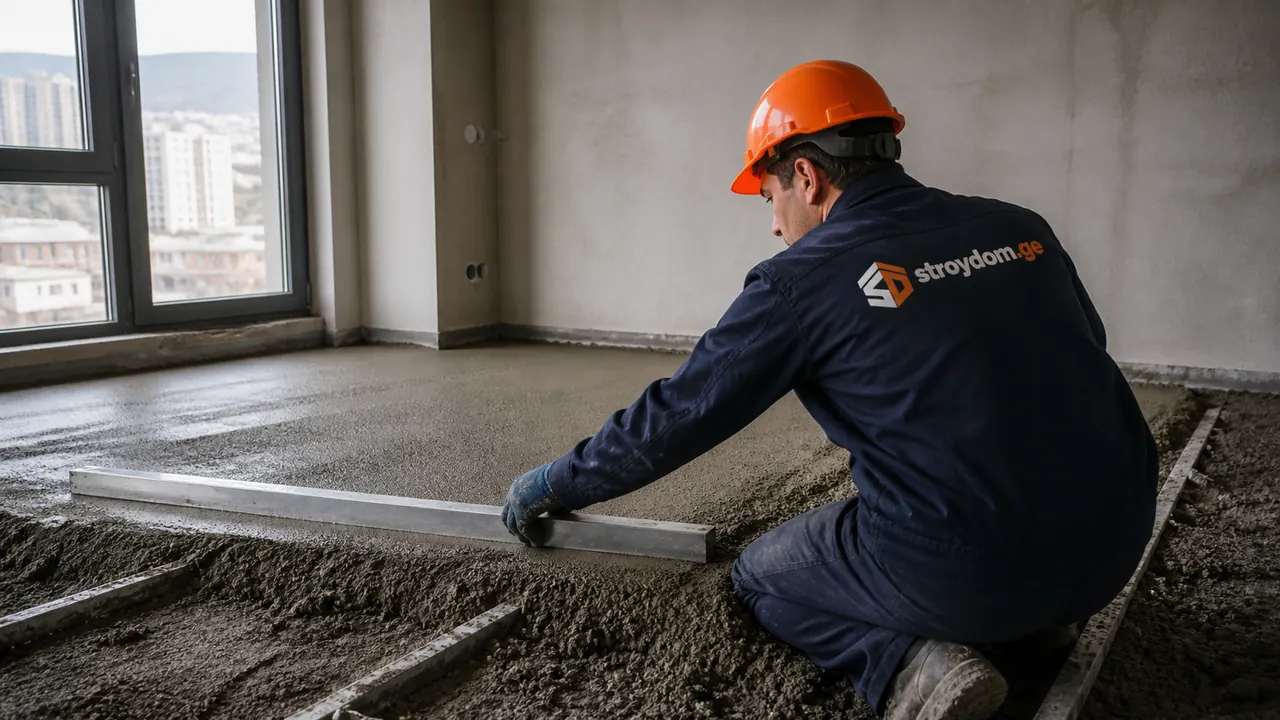
Floor screed
Floor screed in Tbilisi is priced by layer at stroydom.ge: cement-sand up to 50 mm costs 28–42 ₾/m², above that plus 6–10 ₾/m² per extra 10 mm; semi-dry machine-laid with fibre 32–48 ₾/m² from 50 m²; self-levelling 5–15 mm 18–28 ₾/m². Screed over underfloor heating: electric from 95 ₾/m², water-based from 140 ₾/m². Removing old screed costs 15–25 ₾/m², waterproofing 18–28 ₾/m². Two-year warranty, handover with a flatness check. Screed comes within a full build project.
Floor screed in Tbilisi: cement-sand, semi-dry machine-laid and self-levelling. Base preparation, laser-set beacons, fibre or mesh reinforcement, underfloor heating within the screed. Screed is the most underrated stage of a build: nobody sees it in a finished house, yet it decides whether the tile cracks and the laminate starts creaking two years later.
Only as part of a house project
We deliver this line of work only as part of a house project, when we build the house turnkey. We do not take it as a standalone order: a single warranty is only possible when one contractor answers for the whole chain of work.
About the work
How does stroydom.ge deliver floor screed?
A floor flat to within 2 mm over 2 m: the base every finish above it depends on.
What is included in floor screed?
Cement-sand screed
Traditional wet screed 30–80 mm thick with mesh reinforcement: reliable and cheap, but slow to dry.
Semi-dry screed
Machine-laid and pumped through a hose: fast, flat, with no risk of leaking to the flat below.
Self-levelling floors
Self-levelling compounds 5–15 mm thick under laminate, parquet and tile, used as the final levelling layer.
Screed with underfloor heating
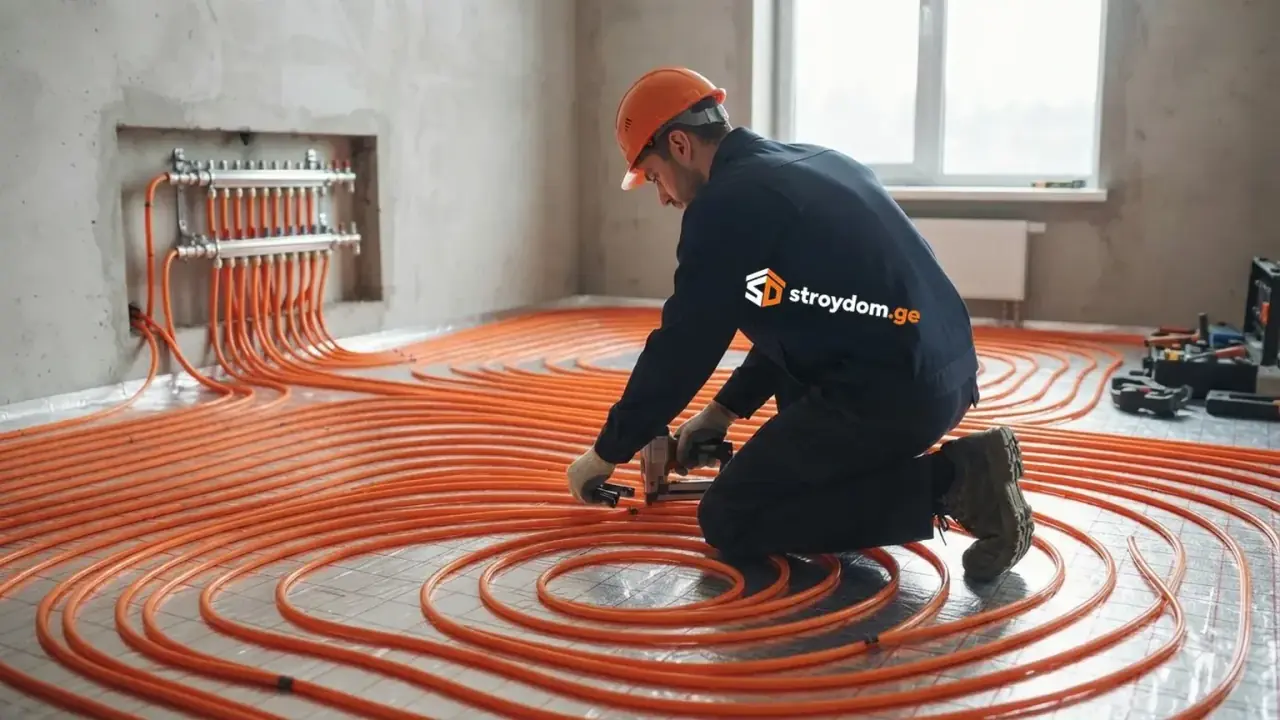
Water or electric underfloor heating installed, pressure-tested and screeded over.
What is floor screed and why is it needed?
A floor screed is the levelling and load-distributing layer between the structural slab and the floor finish. Its quality directly determines how long tile, laminate and parquet survive: with more than 2 mm of deviation over 2 m, porcelain tile works in bending and cracks along the joints, while click laminate wears out its locks and starts to creak. The complaint usually lands on the tiler, though the cause sits two layers below.
Beyond flatness, screed does three more things: it conceals service routes (heating pipes, drainage, cables in conduit), it aligns levels between rooms with different finishes so there are no thresholds in the doorways, and it acts as the heat-spreading layer over underfloor heating. The practical conclusion follows: screed thickness cannot be assigned "as usual". It is calculated from the highest point of the slab, the diameter of the pipes laid, the cover required over the heating, and the load the slab can take.
In Tbilisi we use three types, and the choice depends on the slab type, the schedule and what will be laid on top.
What stages does floor screed consist of?
Each stage runs only after the previous one is accepted — so hidden works are never "closed" before inspection, and a mistake never has to be hunted for through screed and plaster.
- 1
Survey and calculation
Laser survey of level differences across the whole area, a single datum for the entire flat or floor, and calculation of thickness and mortar volume. The datum is set once for the whole project, otherwise floor levels drift between rooms.
- 2
Base preparation
Removing old screed and debris, dust extraction, priming, filling cracks and junctions. On an unprimed base the mortar loses water downwards and never reaches full strength.
- 3
Expansion strip and waterproofing
Perimeter expansion strip and collars around columns; waterproofing in bathrooms and over wet rooms, carried 15–20 cm up the wall.
- 4
Underfloor heating (optional)
Mats or pipe laid at 100–200 mm spacing, fixed to the insulation, the circuit pressure-tested before pouring and kept under pressure throughout the pour.
- 5
Reinforcement
100×100 mm mesh within the screed or polypropylene fibre in the mix. Fibre cuts the risk of shrinkage cracking by 60–70%.
- 6
Beacons
Beacons set with a laser level at 1.5–2 m spacing. Beacons set off a string line drift by 5–7 mm, which is enough to ruin large-format tile.
- 7
Pouring
Mortar delivered, laid between beacons, struck off with a straightedge and power-floated. Work runs continuously within a room, because the joint between yesterday and today becomes a crack.
- 8
Curing and drying
Covered with film for 7 days, kept damp, left to reach the target moisture, and checked with a moisture meter before being handed over for the finish.
How does stroydom.ge control quality on site?
How we work on site — materials, equipment, tolerances, documentation and acceptance of hidden works.
Laser level
Beacons and the datum are set with a laser only, with a check measurement in every room.
Fibre reinforcement
Polypropylene fibre binds microcracks as the mix sets and reduces shrinkage cracking by 60–70%.
Moisture control
Before laminate or parquet we measure residual moisture with a meter (no more than 4% CM) and record the result in the act.
Perimeter strip
Always mandatory. Screed shrinks as it cures; without a compression gap it bears against the walls and cracks, usually at corners and doorways.
Semi-dry in occupied buildings
Less water means faster drying, less shrinkage and no risk of leaking to the floor below, which is often the deciding argument in an inhabited building.
What should be accounted for in Tbilisi and Georgia?
What we account for here: seismic intensity 8 (MSK-64), hot summers and damp winters, steep terrain, older stock with timber floors and worn city networks.
Timber floors
In the older stock of Sololaki, Avlabari and Mtatsminda the floors are timber and cannot carry 80–120 kg/m² of wet screed. We use dry floating floors or lightweight compounds after checking the joists.
Thickness over heating
At least 45 mm over a water pipe, 30 mm over an electric mat. Any less and the screed cracks from thermal cycling in the first heating season.
Seismic and movement joints
On large areas and in doorways we cut movement joints. A 12 m continuous screed slab with no joints will crack; the only question is where.
Drying times
Cement screed dries in 28 days, semi-dry in 7–14 days. Speeding it up with heaters is not allowed: an over-dried surface loses strength while water remains inside and later escapes into the finish.
Large level difference
Where the difference exceeds 8 cm we build up with compacted expanded clay, otherwise both cost and slab loading rise sharply.
Summer heat
In a Tbilisi summer at +35 °C screed loses water within hours and develops a network of cracks. We cover it with film immediately after floating and keep it damp for the first three days.
How much does it cost and how long does it take?
Indicative price ranges in lari (₾) for standard conditions. The final estimate is fixed after measurements and specification approval.
| Item | What is included and the price |
|---|---|
| Cement-sand | Up to 50 mm: 28–42 ₾/m². Above that, plus 6–10 ₾/m² per additional 10 mm. |
| Semi-dry machine-laid | With fibre: 32–48 ₾/m² from 50 m². Below that area, bringing the equipment in is not economical. |
| Self-levelling floors | 5–15 mm under laminate and parquet: 18–28 ₾/m². |
| Screed with underfloor heating | Electric from 95 ₾/m², water-based from 140 ₾/m² including pressure test and manifold. |
| Base preparation | Removing old screed — 15–25 ₾/m², waterproofing — 18–28 ₾/m². |
| Terms | Advance no more than 15%, the balance by stages. 2-year warranty. Work is accepted with a 2 m straightedge flatness check and a moisture record. |
Updated:
Ready to estimate?
Leave a request — engineer site visit, measurement and a preliminary estimate for "floor screed" are free.

Planning to build a house?
Start with a free consultation about your plot, floor area and budget. If you are still looking for land, tell us about a plot you are considering.
We will call within an hour, 24/7. You do not need drawings for the first conversation.
By submitting the form you agree to personal data processing. Privacy Policy
Frequently asked questions — Floor screed
Which is better: wet or semi-dry screed?
Semi-dry dries faster (7–14 days against 28), cannot leak to the neighbours below and shrinks less, so in occupied buildings we usually recommend it. Wet cement-sand screed is cheaper in materials and better for thin layers and complex geometry. Self-levelling compounds are not an alternative but a finishing layer on top of the screed.
How long before I can lay tile or laminate?
Tile can go down once the screed has gained strength and residual moisture no longer affects the adhesive: usually 14–21 days for semi-dry. Laminate and parquet need moisture no higher than 4% CM, which means 28 days for cement screed. Force-drying with heaters is not an option: the surface dries, water stays inside, and the finish lifts a month later.
Why does screed crack?
Three main reasons: no perimeter expansion strip (the screed bears against the walls and tears as it shrinks), drying too fast in a draught or under a heater, and a layer thinner than calculated without reinforcement. Fine surface shrinkage cracks are harmless; through cracks with separated edges mean that section has to be opened up and redone.
How thick must screed be over underfloor heating?
At least 45 mm above the pipe of a water circuit, otherwise the screed cracks from thermal movement. An electric mat needs 30 mm. The thickness is measured from the top of the pipe, not from the slab. This is the point most often forgotten when ceiling height is being saved.
Can screed be laid on a timber floor?
Ordinary cement screed, no. In the older stock of Sololaki, Avlabari and Mtatsminda the floors are timber and were never designed for 80–120 kg/m² of extra load. There we use dry floating floors on expanded clay fill or lightweight polymer-cement compounds, after checking the joists.
What if the floor level varies a lot?
Where the difference exceeds 8 cm, filling it all with mortar is expensive and heavy for the slab. We build up with compacted expanded clay and screed over it, or switch to adjustable joists. The choice follows the slab capacity and how much ceiling height can be given up.