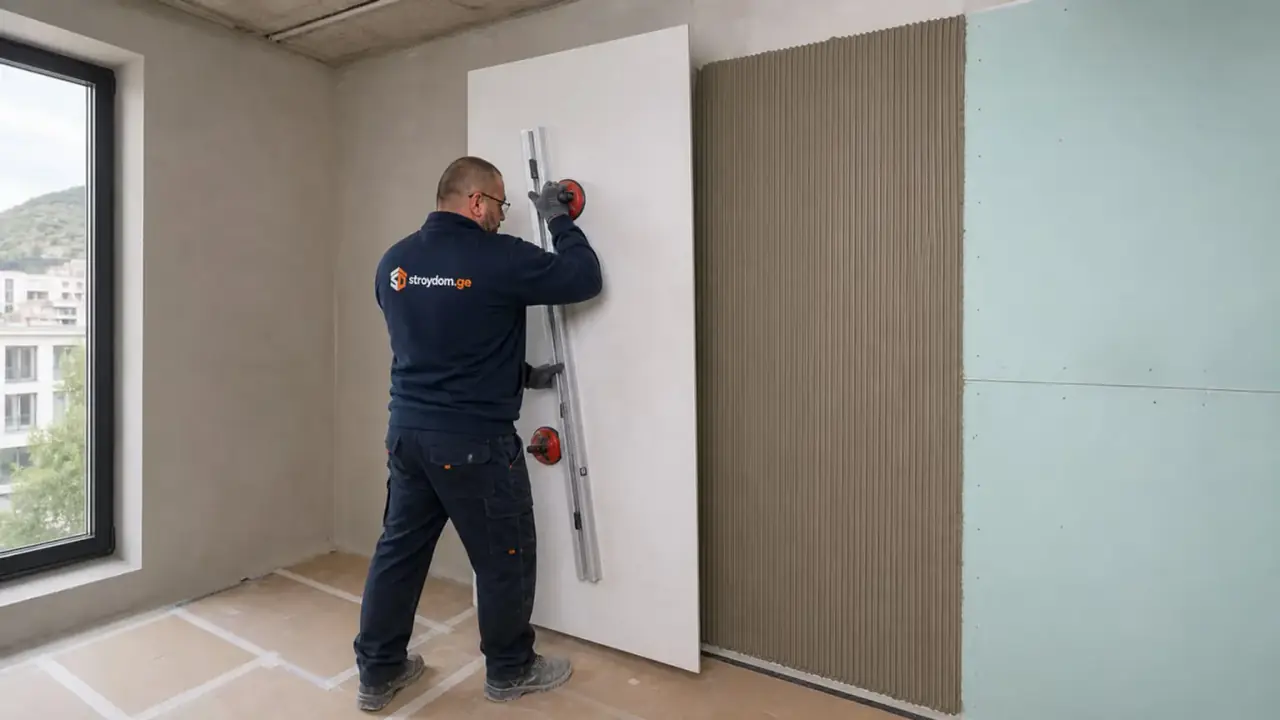
Tile installation
Tiling from stroydom.ge is carried out in Tbilisi only as part of a house project. Floors in 30×60–60×60 cm formats cost 35–50 ₾/m² and bathroom walls 40–55 ₾/m². Large-format slabs of 80×160 cm and above are 70–110 ₾/m². Mosaic is 90–140 ₾/m², facade and terrace tile 60–85 ₾/m². Bathroom waterproofing adds 18–28 ₾/m², epoxy grout a further 25–35 ₾/m², and 45° mitres 12–18 ₾ per linear metre. A fully tiled 5 m² bathroom, excluding tile and sanitary ware, is 1800–2800 ₾ over 5–7 days. Warranty on the work: 2 years.
Professional tiling with substrate preparation, waterproofing of wet areas and careful grouting. We work with ceramics, porcelain, mosaic, clinker, natural stone and large-format slabs. Tile lasts decades, but only if what lies beneath it is right: a flat substrate and a sealed water barrier.
Only as part of a house project
We deliver this line of work only as part of a house project, when we build the house turnkey. We do not take it as a standalone order: a single warranty is only possible when one contractor answers for the whole chain of work.
About the work
How does stroydom.ge deliver tile installation?
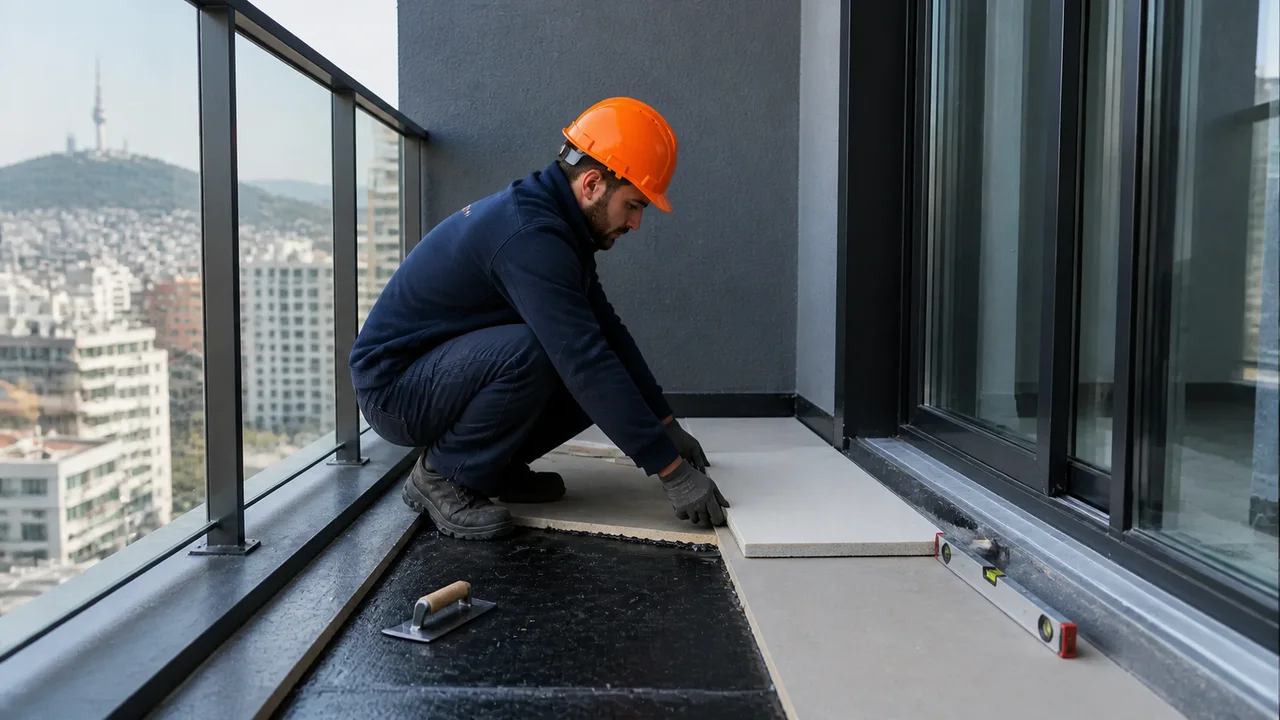
Tile and porcelain laid on walls, floors, facades and terraces, with waterproofing and a set-out drawn in advance.
What is included in tile installation?
Bathrooms
Waterproofing carried up the walls, set-out to the interior design, clean junctions and falls to the drain.
Floors
Laid on screed or underfloor heating with flexible adhesive, levelled with a levelling-clip system.
Terraces and facades
Frost-resistant installation with falls, drainage joints and epoxy grout.
Large format and mosaic
Cutting and fitting 80×160 and 120×260 cm slabs, complex set-outs, near-seamless layouts.
What is tile installation and why is it needed?
Tile and porcelain work in the harshest conditions in the building: constant water, steam, temperature swings, abrasion from shoes and grit. The tile itself is practically permanent. What fails is what lies beneath it.
Mistakes in substrate preparation and waterproofing do not show up at once, but they end in full demolition of the finish and often in repairs to the flat below. Hence the rule we keep: tiling starts with accepting the substrate. Flatness is checked with a 2 m straightedge, moisture with a meter, waterproofing with a flood test.
The second factor is the set-out. Tile is laid not "from the corner" but from axes calculated so that cuts disappear behind the WC and under furniture rather than greeting a visitor at the door. Wall courses should align with floor courses and a joint should land in the centre of a tap, not slice it in half.
That is drawing work done before the first tile is fixed. Large-format slabs add a third factor, equipment: a 120×260 cm slab weighs about 60 kg and requires vacuum suction handles, a levelling rail, an adhesive with extended open time and at least two people, or it simply breaks as it is lifted.
What stages does tile installation consist of?
Each stage runs only after the previous one is accepted — so hidden works are never "closed" before inspection, and a mistake never has to be hunted for through screed and plaster.
- 1
Survey and set-out
Accurate measurement and a set-out to the interior design that minimises cutting and pushes cuts into unseen zones. The client approves it before material is ordered, which is also how the quantity plus 7–10% waste is calculated.
- 2
Substrate preparation
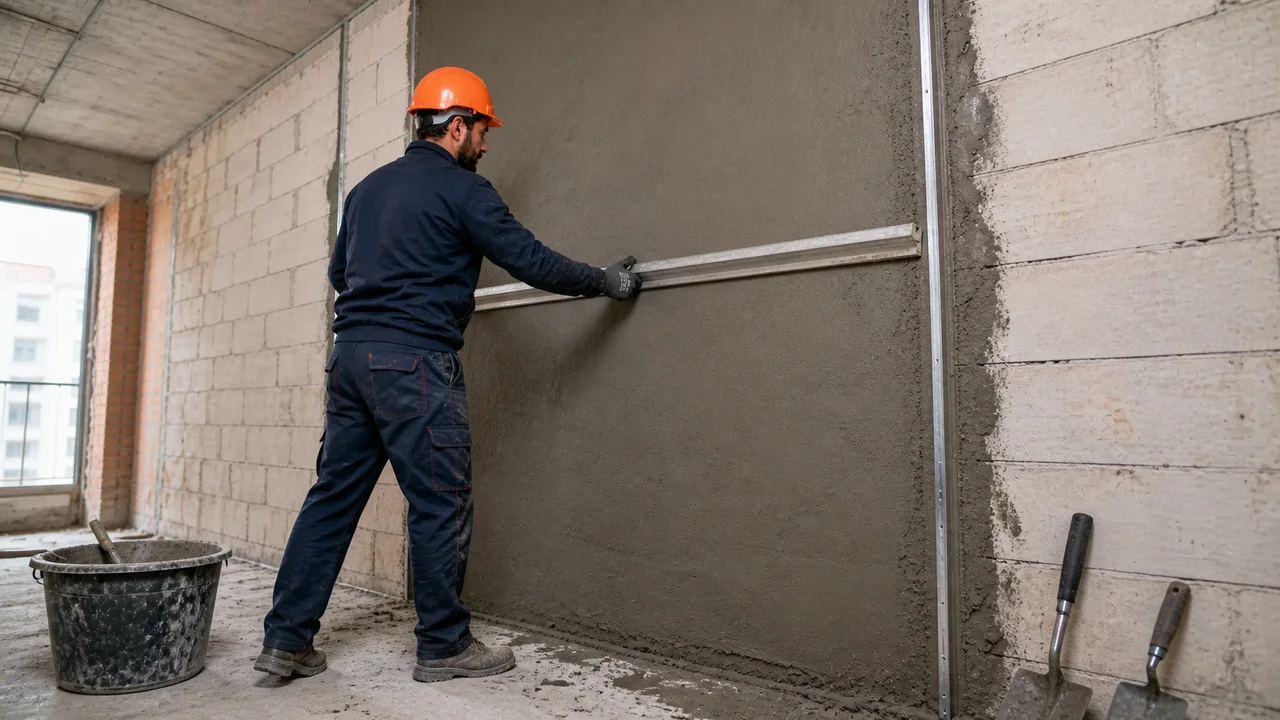
Removing the old finish, levelling walls and floor to beacons, dust extraction, priming. Tile reproduces the substrate rather than levelling it.
- 3
Waterproofing
In wet areas, two coats of liquid membrane with sealing tape at corners and junctions, carried 15–20 cm up the walls and full height in the shower. Verified by a 24-hour flood test.
- 4
Setting out
Laser axes, marking the starting course, and a dry lay to check the pattern and the alignment of joints between floor and walls.
- 5
Fixing
Adhesive applied with a trowel matched to the format, tiles set with a levelling-clip system, every tile checked for level, movement joints at the perimeter.
- 6
Mitres and cuts
45° mitres at external corners instead of plastic trims, and neat cuts around pipes, sockets and access hatches.
- 7
Grouting and sealing
Joints raked out to full depth, cement or epoxy grout applied, internal corners and junctions with sanitary ware sealed with silicone.
How does stroydom.ge control quality on site?
How we work on site — materials, equipment, tolerances, documentation and acceptance of hidden works.
Flatness control
A 2 m straightedge across the diagonals: no more than 2 mm over 2 m, and 1 mm over 2 m for large format.
Adhesive selection
C2TE S1 for large format, flexible for underfloor heating, frost-resistant C2 F for facades and terraces. The adhesive is chosen for the material and exposure, not "one universal bag for everything".
Joints
Calibrated spacers or levelling clips, with the same joint width throughout. 1.5–2 mm for rectified tile, 3 mm for standard. A minimal joint is not "prettier"; it simply forgives no movement.
Cleanliness
Each tile is wiped clean of adhesive immediately and finished surfaces are covered. Adhesive left to harden in a joint can only be removed with the tile.
Acceptance
Sound-testing the whole area for voids, checking falls to the drain with a level, flood-testing the waterproofing and verifying joint alignment.
What should be accounted for in Tbilisi and Georgia?
What we account for here: seismic intensity 8 (MSK-64), hot summers and damp winters, steep terrain, older stock with timber floors and worn city networks.
Out-of-true walls in older stock
In Sololaki and Avlabari deviations reach 5–8 cm over 3 m. Plaster on beacons or board lining comes first, tile second. Thickness of adhesive cannot compensate: a bed over 15 mm delaminates.
Heat
At +30 °C the adhesive loses half its open time. We work in small bays, damp down the walls, and never spread more adhesive than we can cover in 10–15 minutes.
Terraces and facades
Frost-resistant tile with water absorption below 0.5%, epoxy grout, a fall of at least 1.5% away from the wall, and drainage joints. Interior tile outdoors fails within one or two winters.
Large format
For 80×160 and 120×260 cm slabs: vacuum handles, levelling rails, extended open-time adhesive and a crew of at least two. The substrate must be twice as flat as for standard tile.
Near-seamless layouts
Rectified tile with a 1 mm joint and colour-matched epoxy grout reads as solid stone. But such a joint accommodates no movement, so the substrate must be stable and fully dry.
Underfloor heating start-up
Tile goes down on flexible adhesive and the system is switched on no earlier than 28 days later, raising the temperature by 5 °C a day. Heating a fresh installation quickly pulls the tile off the substrate.
How much does it cost and how long does it take?
Indicative price ranges in lari (₾) for standard conditions. The final estimate is fixed after measurements and specification approval.
| Item | What is included and the price |
|---|---|
| Standard format | Floor tiling 30×60–60×60 cm: 35–50 ₾/m²; bathroom walls: 40–55 ₾/m². |
| Large format | Slabs 80×160 cm and above: 70–110 ₾/m², reflecting the equipment and two-person handling. |
| Mosaic and facade | Mosaic: 90–140 ₾/m²; facade and terrace tile: 60–85 ₾/m². |
| Extras | Bathroom waterproofing: 18–28 ₾/m²; epoxy grout: plus 25–35 ₾/m²; 45° mitres: 12–18 ₾ per linear metre. |
| Bathroom, fully tiled | 5 m² (excluding tile and sanitary ware): 1800–2800 ₾ over 5–7 days, plus a day for the waterproofing test. |
| Terms | Prices are fixed after the survey and the approved set-out. Warranty on the work: 2 years. |
Updated:
Ready to estimate?
Leave a request — engineer site visit, measurement and a preliminary estimate for "tile installation" are free.

Planning to build a house?
Start with a free consultation about your plot, floor area and budget. If you are still looking for land, tell us about a plot you are considering.
We will call within an hour, 24/7. You do not need drawings for the first conversation.
By submitting the form you agree to personal data processing. Privacy Policy
Frequently asked questions — Tile installation
Is waterproofing under bathroom tile really necessary?
Always. Neither the grout joint nor the tile itself is watertight: water passes through the grout and accumulates in the screed. Without waterproofing, a leak to the flat below is a matter of time, and putting it right costs many times the 18–28 ₾/m² of a liquid membrane. We carry the membrane 15–20 cm up the walls, and full height in the shower.
How does cement grout differ from epoxy?
Cement grout is cheaper, easier to apply and to repair, but it absorbs water and dirt, darkens, and needs renewing after 4–6 years. Epoxy absorbs nothing, resists chemicals and chlorine, and lasts decades. It is used in showers, kitchen splashbacks, pools and terraces. It costs 25–35 ₾/m² more and repays that the first time mould does not appear.
Why does tile sound hollow and come loose?
Voids under a tile mean the adhesive was dabbed on or the wrong notched trowel was used. The tile holds until it meets a point load or thermal movement, and then it cracks or lifts. We apply adhesive as a full bed with a trowel matched to the format, and sound-test the whole area at handover.
Can tile be laid over underfloor heating?
Yes, and it is the best pairing: porcelain conducts heat well. But it needs a flexible C2TE S1 adhesive and mandatory movement joints around the perimeter and across areas over 25–30 m². The heating is switched on no earlier than 28 days after laying, raising the temperature gradually.
How do I choose tile for a terrace in Tbilisi?
By three criteria: water absorption below 0.5% (frost resistance), an anti-slip R10–R11 surface, and at least 9 mm thickness. Ordinary interior tile survives one or two winter cycles outdoors: water enters the pores, freezes and tears off the surface. The fall away from the wall must be at least 1.5%, otherwise water stands at the threshold.
What if the walls in an old building are out of true?
In Sololaki and Avlabari deviations reach 5–8 cm over three metres. Laying tile "on thicker adhesive" is not an option: a bed over 15 mm does not hold and cracks. We first straighten the walls with plaster on beacons or line them with moisture-resistant board, and only then tile. This is a separate line in the estimate that is fairer to state before the start.