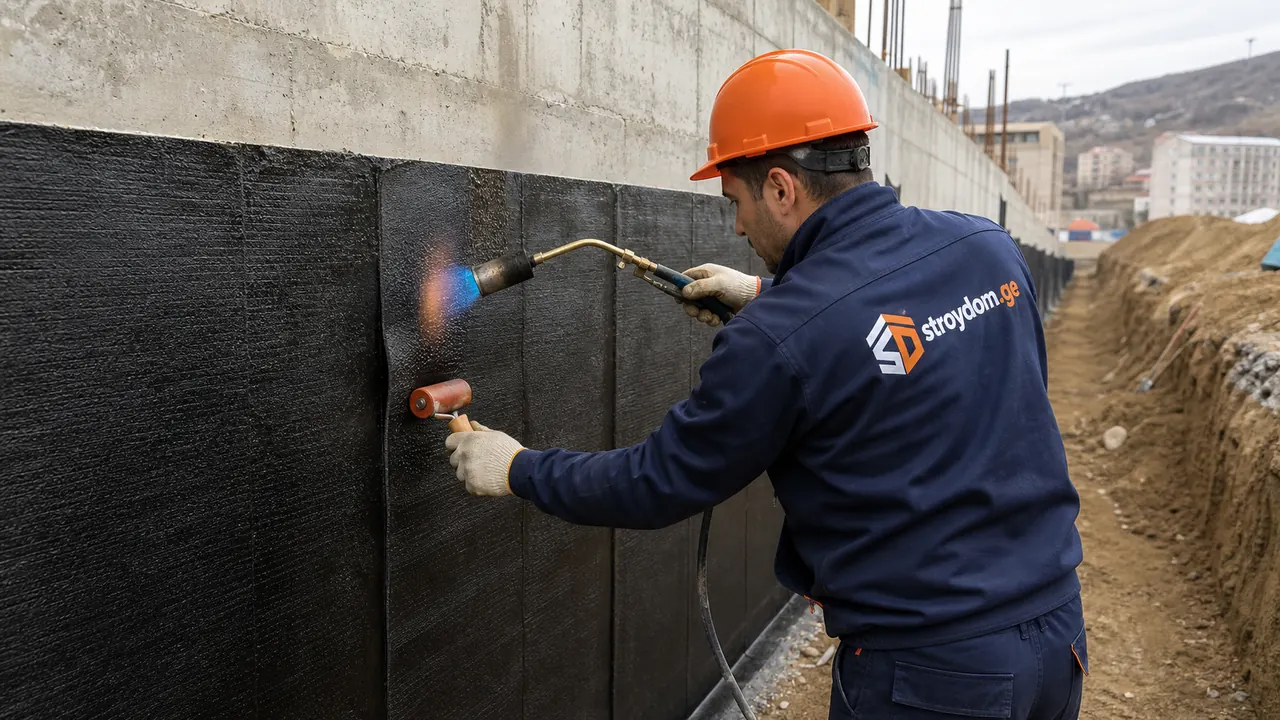
Waterproofing
stroydom.ge waterproofs buildings in Tbilisi and across Georgia as part of a comprehensive project. Guide prices before the survey: a two-coat applied system in wet rooms costs 18–28 GEL/m², corner tapes and pipe collars 12–18 GEL per linear metre. Tanking to foundation walls costs 22–35 GEL/m², a damp-proof course 25–40 GEL/m². PVC and TPO membrane on roofs and terraces costs 28–45 GEL/m², tapered falls 20–35 GEL/m². Injection work costs 90–150 GEL per linear metre. A site visit with leak diagnosis costs 150–350 GEL and is credited against the estimate.
We waterproof every level of a building in Tbilisi and across Georgia: liquid-applied and sheet systems for foundations and basements, membrane waterproofing for flat roofs, terraces and balconies, cementitious systems in wet rooms, plus leak diagnosis and repair.
Only as part of comprehensive projects
We deliver this line of work inside a comprehensive project — building a turnkey house or fitting out a property in full. We do not take it as a standalone order: a single warranty is only possible when one contractor answers for the whole chain of work.
About the work
How does stroydom.ge deliver waterproofing?
Keeping water out of the structure, from the foundation to the roof.
What is included in waterproofing?
Foundations and basements
Vertical tanking and damp-proof course, drainage, protection from ground water.
Flat roofs
PVC and TPO membranes, tapered falls, outlets, junctions and parapets.
Terraces and balconies
Waterproofing under tiles with falls to the drainage and gullies.
Wet rooms
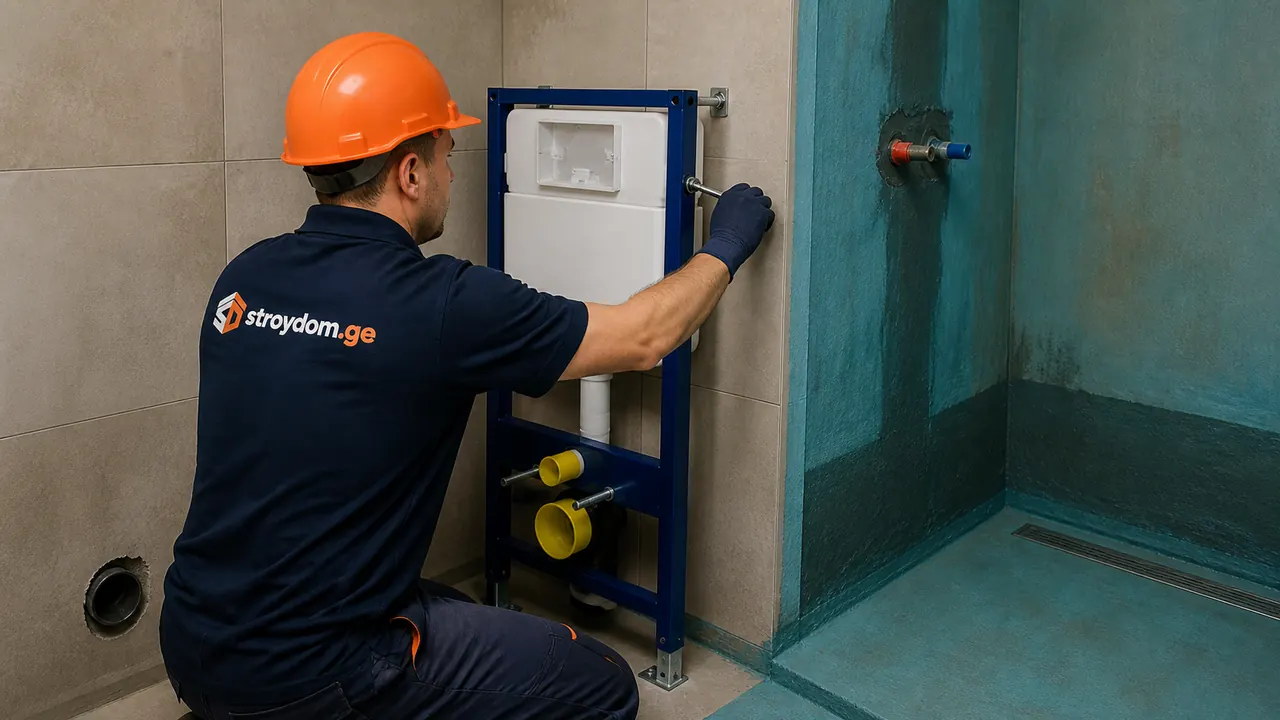
Cementitious systems, sealing tape at corners and junctions, pipe collars.
Leak diagnosis
We trace the real path of the water and fix the cause, not the symptom.
What is waterproofing and why is it needed?
Waterproofing is the layer nobody sees and everybody remembers once a stain appears on the ceiling below. Its cost during construction is nothing next to the cost of the consequences: a soaked slab, ruined finishes in the flat below, tiling opened up again. So we build it as a continuous system: material matched to the structure, details checked, and a mandatory test before screed or tiles go on top.
What stages does waterproofing consist of?
Each stage runs only after the previous one is accepted — so hidden works are never "closed" before inspection, and a mistake never has to be hunted for through screed and plaster.
- 1
Survey
Structure, moisture regime, source of water, condition of the substrate.
- 2
System selection
Liquid-applied, sheet, membrane or injection, chosen per detail.
- 3
Substrate preparation
Cleaning, crack repair, chasing, coving at corners, priming.
- 4
Falls
Tapered falls to drainage on roofs, terraces and in shower zones.
- 5
Main layer
Two coats or welded sheets with laps and thickness control.
- 6
Details
Sealing tape at corners, collars on pipes, gullies and outlets treated.
- 7
Testing
Flood test for 24 hours before screed and tiling.
- 8
Handover
Photo record of concealed layers, concealed works certificate, warranty.
How does stroydom.ge control quality on site?
How we work on site — materials, equipment, tolerances, documentation and acceptance of hidden works.
Test before closing up
Wet areas are flooded for a day: leaks are found now, not after the tiling.
Two coats, not one
The second coat runs perpendicular to the first, covering any missed areas.
Details matter more than area
Leaks almost always start at a corner, a junction or a pipe, not on a flat plane.
Material compatibility
Bitumen and polymers do not always mix: we build the system from compatible layers of one manufacturer.
Documents
Material data sheets, concealed works certificate, warranty terms in the contract.
What should be accounted for in Tbilisi and Georgia?
What we account for here: seismic intensity 8 (MSK-64), hot summers and damp winters, steep terrain, older stock with timber floors and worn city networks.
Tbilisi downpours
A summer storm tests falls and outlets within an hour. Drainage is sized by area, not by habit.
Clay soils and slopes
Water runs down the slope towards the foundation. Waterproofing works together with drainage and the apron.
The coast
Batumi, Kobuleti and Gonio are humid year-round: durable systems and ventilated build-ups come first.
Seismic cracking
Rigid cementitious coatings tear when the structure moves. In risk areas we use elastic polymer systems.
Older housing stock
Soviet-era buildings often have no damp-proof course in the wall. It is restored by injection from inside.
How much does it cost and how long does it take?
Indicative price ranges in lari (₾) for standard conditions. The final estimate is fixed after measurements and specification approval.
| Item | What is included and the price |
|---|---|
| Guide prices (Tbilisi, before survey) | The figures below are a working guide for budgeting. The firm estimate follows a site visit and survey: scope, access and substrate condition all move the price. |
| Wet rooms | Two-coat applied system: 18–28 GEL/m²; corner tapes and pipe collars: 12–18 GEL per linear metre. |
| Foundations and basements | Applied and sheet tanking to foundation walls: 22–35 GEL/m²; damp-proof course: 25–40 GEL/m². |
| Roofs and terraces | PVC and TPO membrane with junctions: 28–45 GEL/m²; tapered falls: 20–35 GEL/m². |
| Injection systems | Restoring a damp-proof course in an existing wall: 90–150 GEL per linear metre. |
| Survey | Site visit with leak diagnosis: 150–350 GEL, credited against the estimate if you proceed. |
| How we price | The estimate splits area from details: flat surfaces are cheaper, while junctions, corners and pipe penetrations drive the cost. |
| What drives the price | Type of structure (foundation, roof, terrace, bathroom), chosen system, substrate condition and the amount of preparation. |
| Leak diagnosis | A survey to find the cause is quoted separately and comes before repair: until the cause is known, repair is pointless. |
| As part of a build | On turnkey projects waterproofing belongs to its construction stage and is included in the house estimate. |
| Terms | Fixed estimate in GEL, staged payments, warranty in the contract (up to 10 years on full-cycle work). |
Updated:
Ready to estimate?
Leave a request — engineer site visit, measurement and a preliminary estimate for "waterproofing" are free.

Planning to build a house?
Start with a free consultation about your plot, floor area and budget. If you are still looking for land, tell us about a plot you are considering.
We will call within an hour, 24/7. You do not need drawings for the first conversation.
By submitting the form you agree to personal data processing. Privacy Policy
Frequently asked questions — Waterproofing
Where do Georgian houses leak most often?
Three typical places. First, junctions and parapets on flat roofs, where water arrives from a large area. Second, terraces and balconies above living rooms: they are often built with no fall and no waterproofing under the tiles, so water goes into the slab. Third, bathrooms, where waterproofing is either skipped or applied only to the floor, missing the 20–30 cm up the walls and the full height of the shower zone.
Liquid-applied, sheet or membrane: what is the difference?
Liquid-applied (cement-polymer) goes on with a brush or trowel and handles complex geometry well: bathrooms, trays, junctions. Sheet bitumen is reliable on foundations and horizontal surfaces but dislikes complex details. PVC and TPO membranes are the standard for flat roofs: sheets are hot-air welded and the seam ends up stronger than the material. The structure decides the choice, not the price per roll.
Do foundations in Tbilisi need waterproofing?
Yes, in two forms. Vertical tanking protects foundation walls from soil moisture; a horizontal damp-proof course stops water rising by capillary action into the walls. Tbilisi has many clay-soil plots that drain badly, and on the slopes of Vake, Saburtalo and the suburbs rainwater runs along the slope. Without a damp-proof course, damp climbs the wall and shows on the ground floor within a couple of years.
How do you find a leak when there is a stain on the ceiling?
The stain is almost never under the source: water travels along the slab, along pipes and across the screed, then comes down at the weakest point. So instead of opening everything up, we follow the logic: check risers and runs, junction zones, the fall of the terrace or roof above, and flood-test in sections if needed. That is cheaper and faster than stripping the finishes.
Can waterproofing be added after finishing?
Only partly, and with a worse result. Proper waterproofing is a concealed layer laid on a prepared substrate before screed and tiles. After finishing, only palliatives remain: impregnation, joint sealing, injection into cracks from inside. They relieve the symptom for a while but do not replace a continuous system.
What matters for terraces above living rooms?
A 1–2% fall to the drainage, waterproofing under the tiles across the whole area and turned up the walls, a gully or channel with an inspection point, and a drainage layer that removes water from under the tiles. Without a fall, water sits on the waterproofing and finds the weak spot at a junction. The room under a terrace is the most common site of complicated leaks.