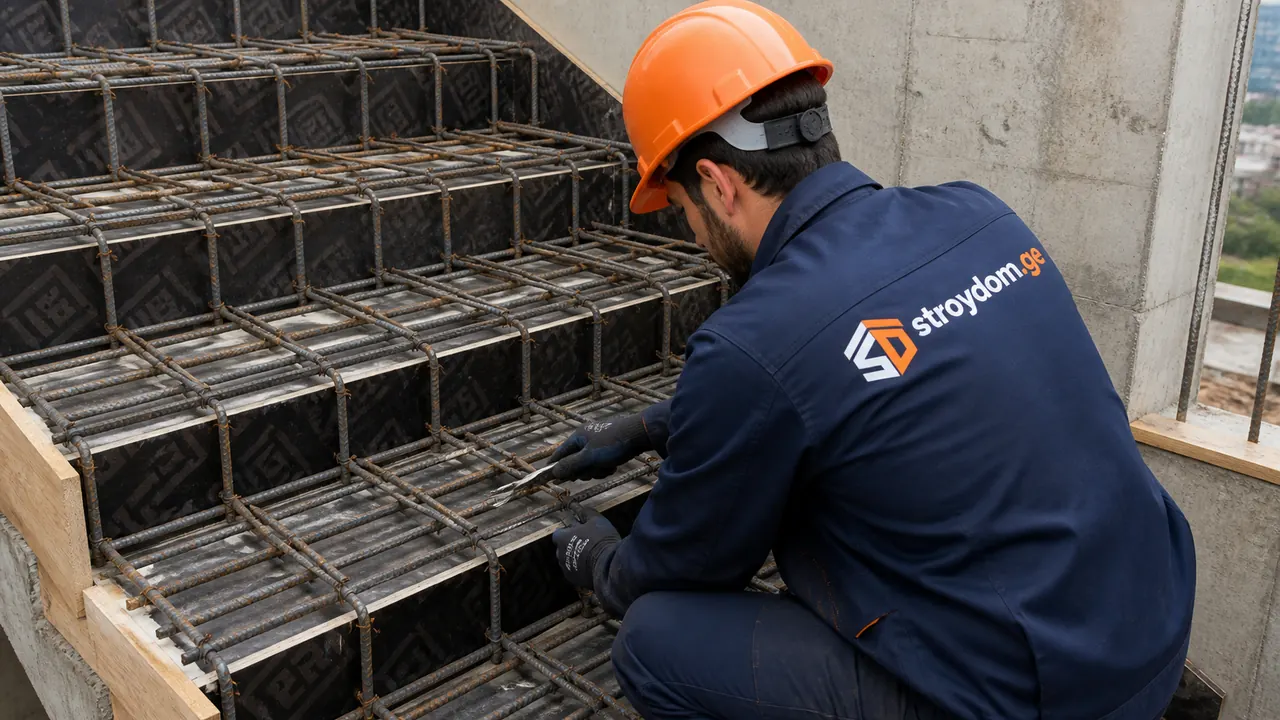
Concrete stairs
A cast concrete stair in Tbilisi costs at stroydom.ge: a straight flight per floor 2800–4500 GEL for formwork, reinforcement and concrete with materials; a turning or U-shaped stair with landing 4500–7500 GEL; spiral and cantilevered 7000–13000 GEL. Tread finishes are extra: porcelain tile 90–150 GEL per step, natural stone 140–260 GEL, ground concrete 55–90 GEL. Balustrades cost from 180 GEL per linear metre. The estimate is fixed in GEL, with a 10-year structural warranty. Within a house build the stair is cast together with the slabs.
We design and cast reinforced concrete stairs in private houses and commercial buildings in Tbilisi: straight and turning flights, U-shaped with landings, spiral and cantilevered floating treads, finished in stone, porcelain tile or timber.
Available as a separate order from 1,000 GEL
We take this work as a standalone order from 1,000 GEL, or as part of a turnkey house project. Inside a house project one contractor answers for the whole chain of work: one estimate and one warranty.
About the work
How does stroydom.ge deliver concrete stairs?
Cast concrete stairs in any geometry, from a straight flight to a spiral.
What is included in concrete stairs?
Setting out
Riser height and tread depth worked out against the opening and ceiling.
Formwork
Laminated plywood for a smooth finish, curved formwork for spiral flights.
Reinforcement
Rebar cage at calculated spacing, anchored into the slab and walls.
Concreting
B25–B30 concrete placed in layers, vibrated and cured properly.
Tread finishes
Ground concrete, stone, porcelain tile or timber, plus balustrade installation.
What is concrete stairs and why is it needed?
A stair is something people use ten times a day and at the same time a structural element of the house. Awkward geometry or a reinforcement mistake cannot be corrected with finishes: a centimetre of variation between steps stays forever, and inadequate anchorage in a seismic area is a real risk. That is why we set out and calculate the stair before the slabs are poured, so the rebar starters and the opening are in the right place from the start.
What stages does concrete stairs consist of?
Each stage runs only after the previous one is accepted — so hidden works are never "closed" before inspection, and a mistake never has to be hunted for through screed and plaster.
- 1
Survey and calculation
Floor height, opening, pitch, number and size of steps, headroom check.
- 2
Structural design
Flight thickness, reinforcement layout, bearing and anchorage details.
- 3
Formwork
Laminated plywood to the setting out; curved templates for spirals.
- 4
Reinforcement
Main and distribution bars, starters into slab and walls, cover spacers.
- 5
Concreting
B25–B30 concrete, vibrated, steps formed from the bottom up.
- 6
Curing and striking
Kept damp for the first days, formwork struck after 14–21 days by strength gain.
- 7
Preparation for finishes
Grinding, correcting tread geometry, preparing the edges.
- 8
Finishes and balustrade
Stone, porcelain tile or timber, handrails and guarding installed.
How does stroydom.ge control quality on site?
How we work on site — materials, equipment, tolerances, documentation and acceptance of hidden works.
Laser setting out
Every step is levelled: an identical riser throughout the flight is non-negotiable.
Cover control
Rebar sits on spacers: bars left at the surface corrode and split the concrete from inside.
Tied into the building
Rebar starters into slab and walls with calculated anchorage: the detail that matters in an earthquake.
Curing
Concrete is kept damp and shaded for the first days: concrete dried too fast cracks and loses strength.
Photo record
Reinforcement and details are photographed before the pour, because afterwards there is no way to check.
What should be accounted for in Tbilisi and Georgia?
What we account for here: seismic intensity 8 (MSK-64), hot summers and damp winters, steep terrain, older stock with timber floors and worn city networks.
Headroom
At least 200 cm is needed above every step. This is the most commonly forgotten dimension, and the stair ends up hitting the opening.
Houses on slopes
Vake, Saburtalo and the suburbs have many sloping plots: external steps and retaining walls are designed together with the site layout.
Finish thickness
Stone or tile adds 2–4 cm to each step. That is built into the concrete geometry, or the top step ends up lower than the rest.
Casting in heat
Tbilisi summers set concrete faster than normal: we pour early in the morning, use admixtures and cover the surface.
Curing time
Striking formwork early is the most common cause of cracks in a flight. Strength gain can only be sped up by concrete grade and admixtures.
How much does it cost and how long does it take?
Indicative price ranges in lari (₾) for standard conditions. The final estimate is fixed after measurements and specification approval.
| Item | What is included and the price |
|---|---|
| Guide prices (Tbilisi, before survey) | The figures below are a working guide for budgeting. The firm estimate follows a site visit and survey: scope, access and substrate condition all move the price. |
| Straight flight | Formwork, reinforcement and concrete for one flight per floor: 2800–4500 GEL (labour with materials, excluding tread finishes). |
| Turning and U-shaped | With a landing, 4500–7500 GEL: more formwork and a more complex rebar cage. |
| Spiral and cantilevered | 7000–13000 GEL: curved formwork from templates and reinforcement to a radius. |
| Tread finishes | Porcelain tile: 90–150 GEL per step; natural stone: 140–260 GEL; ground concrete: 55–90 GEL (labour). |
| Balustrade | Steel or glass balustrade installation: from 180 GEL per linear metre. |
| How we price | The estimate follows the structure: formwork, reinforcement, concrete and labour as separate lines, tread finishes as a separate section. |
| What drives the price | Geometry (straight, turning, spiral, cantilevered), flight thickness, floor height, concrete access and the type of finish. |
| Spiral and cantilevered | More expensive than a straight flight because of curved formwork and more complex reinforcement. The difference is priced before work starts. |
| As part of a house | On turnkey builds the stair belongs to the concrete works and is cast with the slabs, which is cheaper than a separate visit. |
| Terms | Fixed estimate in GEL, staged payments, structural warranty in the contract: 10 years on full-cycle work. |
Updated:
Ready to estimate?
Leave a request — engineer site visit, measurement and a preliminary estimate for "concrete stairs" are free.

Planning to build a house?
Start with a free consultation about your plot, floor area and budget. If you are still looking for land, tell us about a plot you are considering.
We will call within an hour, 24/7. You do not need drawings for the first conversation.
By submitting the form you agree to personal data processing. Privacy Policy
Frequently asked questions — Concrete stairs
Why choose cast concrete over steel or timber?
Concrete becomes part of the building structure: it does not creak, dry out or need fixings retightened, and it carries load without weight limits. Timber starts creaking at the joints over time; a steel frame transmits vibration and sound through the house. Concrete costs more to cast, but over 15–20 years it works out cheaper because there is no maintenance at all.
What tread dimensions are comfortable?
The working rule is 2h + b = 60–64 cm, where h is the riser and b the tread. For a house that means a 16–18 cm riser and a 28–30 cm tread. Risers over 19 cm tire you going up; treads under 25 cm are dangerous coming down because the foot does not fit. Every step in a flight is made identical: even a centimetre of difference breaks your stride and causes falls.
How much harder is a spiral stair?
Harder and more expensive, because all the formwork is curved: it is built from bent plywood templates and the rebar cage is tied to a radius with varying spacing. In return a spiral occupies a circle of 160–220 cm instead of the 3–4 m² a straight flight needs, and on a tight plot that is the deciding argument. Tread width on a spiral is measured along the walking line, 40–45 cm from the inner edge.
What about seismic design?
Tbilisi and most of Georgia are seismic, so the stair is not a separate object: it is tied rigidly into slabs and walls through rebar starters with a calculated anchorage length. A flight simply resting on a slab acts as a battering ram during a tremor. We cast the starters in advance, while the slab is poured. Doing it later means drilling and chemical anchors, and costs more.
How long does a stair take?
Formwork and reinforcement take 3–6 days depending on geometry, casting one day, and curing before striking the formwork 14–21 days. Removing it earlier is not an option, since concrete has only reached part of its design strength by then. That is roughly a month to being ready for finishes. A spiral adds a few days for the curved formwork.
Can a stair be cast in a finished house?
Yes, if there is an opening in the slab and a way to get concrete in. The difficulty in a finished house is elsewhere: protecting existing finishes, delivering concrete (by pump or by hand where a mixer cannot reach) and dust from drilling for rebar starters. We plan such work separately and agree protection measures in the contract.