Welding and metalwork
Welding and metalwork from stroydom.ge is delivered in Tbilisi as part of a complete project: frames, trusses, staircases, canopies, gates and railings built to drawings. Mild steel structures cost 6–12 ₾ per kg of finished structure, fabrication and erection included. Fences and railings in hollow section are 60–120 ₾ per linear metre including paint. AISI 304 stainless railings on posts cost 220–380 ₾ per linear metre. Swing gates with automation are 1800–4500 ₾, sliding gates from 5500 ₾ with a carrier beam and drive. Site welding is 8–14 ₾ per metre of weld. The price is fixed after the survey.
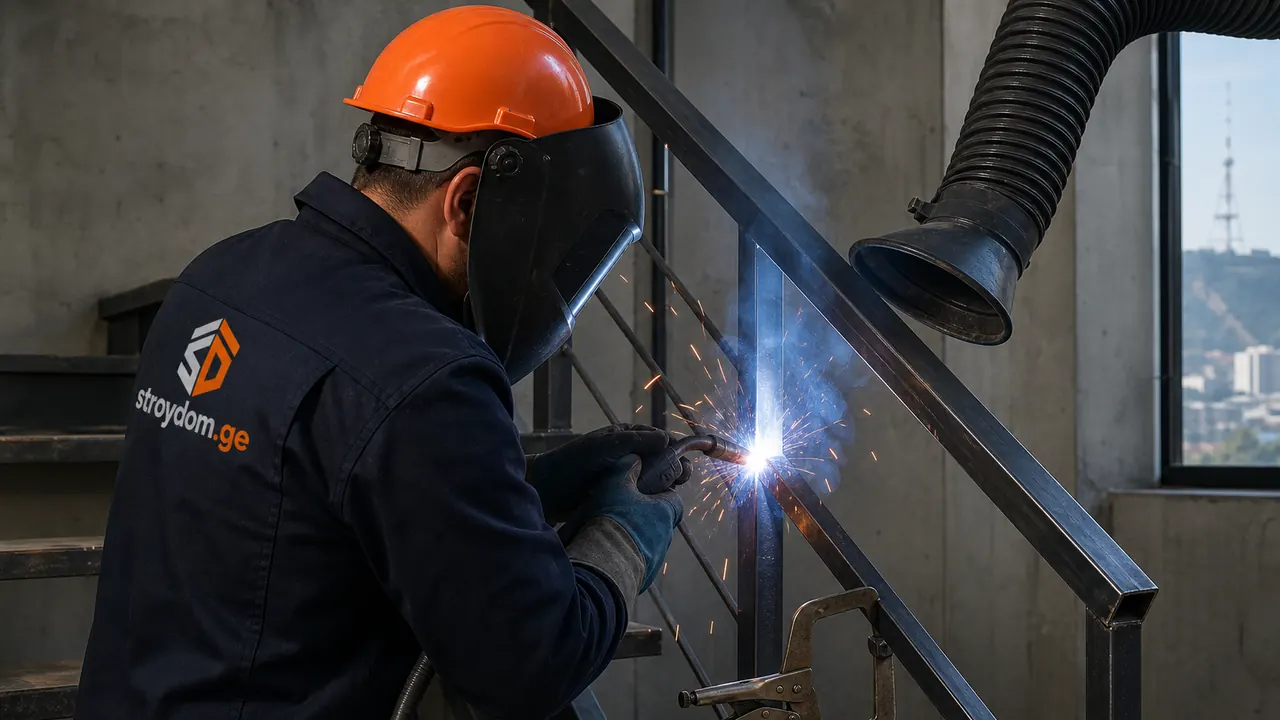
We fabricate and install steel structures: frames, trusses, staircases, canopies, gates and railings. We weld with stick, MIG/MAG and TIG on mild steel, galvanised steel and stainless. Every load-bearing element is calculated for its actual load rather than chosen by eye from the wall thickness of a tube.
Only as part of a house project
We deliver this line of work only as part of a house project, when we build the house turnkey. We do not take it as a standalone order: a single warranty is only possible when one contractor answers for the whole chain of work.
About the work
How does stroydom.ge deliver welding and metalwork?
Steel that actually carries load: frames, staircases, canopies and gates, built to drawings with calculated sections.
What is included in welding and metalwork?
Steel structures
Columns, beams, trusses, floor structures and double-height frames, to design with shop drawings.
Staircases and railings
Stringers, straight and spiral stairs, railings in mild and stainless steel calculated for lateral load.
Gates and doors
Swing and sliding gates, technical doors and wickets with automation and embedded parts for the drive.
TIG / stainless
TIG welding of railings, handrails and small forms in AISI 304/316 with a clean visible weld.
What is welding and metalwork and why is it needed?
Welding is structural work, not decoration. A double-height frame, a steel staircase, a canopy over the entrance, a sliding gate, embedded parts for glazing: all of them are loaded elements with a calculated capacity and a limit. A bad weld does not fail immediately: it produces a microcrack that grows cycle by cycle and shows up a year or two into service, usually under load and at the worst moment.
So we work to drawings, calculate sections for the actual loads, set welding parameters for the steel grade and thickness, and use certified welders. The second most important factor after the weld itself is corrosion protection. Tbilisi is dry and steel lives longer here than on the coast, which is why owners economise on protection and later find rust in the joints where water gets in: open tube ends, seams behind gussets, base plates standing directly on concrete without a separating layer.
On our sites every structural weld is cleaned, primed and top-coated, and hollow sections are sealed with end caps, which is cheaper than any later repair.
What stages does welding and metalwork consist of?
Each stage runs only after the previous one is accepted — so hidden works are never "closed" before inspection, and a mistake never has to be hunted for through screed and plaster.
- 1
Survey and drawing
A site visit, measurement in place, and a fabrication drawing with details and a steel schedule. Measuring on site is mandatory: design and as-built dimensions almost always differ.
- 2
Calculation and material selection
Sections calculated for the load, selection of sections, hollow sections and plate to GOST/EN, and verification of batch certificates.
- 3
Shop fabrication
Plasma or saw cutting, drilling, edge preparation for welding. Shop conditions give better accuracy and cleaner welds than assembling everything in place.
- 4
Erection and welding
Assembly to level, tacking, geometry checks, then welding out in the specified sequence so thermal distortion does not pull the structure out of true.
- 5
Corrosion protection
Removing slag and mill scale, degreasing, priming with alkyd or epoxy, top coat in hammer finish or RAL, and end caps on hollow sections.
- 6
Handover
Geometry check, load test on stairs and railings, and a hidden-works certificate with photos of the joints before painting.
How does stroydom.ge control quality on site?
How we work on site — materials, equipment, tolerances, documentation and acceptance of hidden works.
MMA — stick
Stick welding for site erection: 3–12 mm thickness, all positions, workable in wind and confined spaces.
MIG/MAG
In the shop for repetitive and long welds: high speed, clean slag-free welds, consistent quality in production.
TIG
Stainless, aluminium, thin material and visible welds: handrails and decorative work. Slow and costly, but needs no grinding afterwards.
Cutting
Plasma for plate up to 20 mm, angle grinder for sections, chop saw for accurate 90° and 45° cuts.
Inspection
Visual and dimensional inspection on all welds, ultrasonic testing on critical joints. Photos of the joints before painting go to the client: once the enamel is on, the weld can no longer be judged.
What should be accounted for in Tbilisi and Georgia?
What we account for here: seismic intensity 8 (MSK-64), hot summers and damp winters, steep terrain, older stock with timber floors and worn city networks.
Seismic loads
Georgia is an intensity-8 seismic zone: rigid frame joints get gussets and a weld run around the full contour, not spot tacks. A four-tack joint passes a static check and fails under reversing load.
Thin stainless
AISI 304 at 1.5 mm is TIG welded at low current with argon backing, otherwise the reverse side of the weld darkens and loses corrosion resistance.
Galvanised steel
We grind 30 mm clear of zinc before welding and apply cold galvanising spray afterwards. Ventilation is mandatory: zinc oxide fumes are toxic.
Work at height
Fall arrest, staging and a fire watch with water and an extinguisher when working near insulation or timber, because grinder sparks carry up to 10 m.
Condensation and wind
At −5 °C and below we preheat the metal with a torch, otherwise the weld develops cold cracks. In strong wind the shielding gas blows away and MIG produces porous welds.
Dissimilar metals
Mild and stainless steel cannot be joined directly without isolation: a galvanic couple forms and the mild steel corrodes rapidly. Such joints get an isolating washer or a transition piece.
How much does it cost and how long does it take?
Indicative price ranges in lari (₾) for standard conditions. The final estimate is fixed after measurements and specification approval.
| Item | What is included and the price |
|---|---|
| Mild steel structures | Frames, canopies, staircases: 6–12 ₾ per kg of finished structure, fabrication and erection included. |
| Hollow section work | Fences and railings: 60–120 ₾ per linear metre including paint. |
| Stainless | AISI 304 railings on posts: 220–380 ₾ per linear metre. |
| Gates | Swing gates with automation: 1800–4500 ₾; sliding gates from 5500 ₾ with a carrier beam and drive. |
| Site welding | 3 mm electrode: 8–14 ₾ per metre of weld, excluding steel. |
| Terms | The price is fixed after the survey. Advance no more than 15%, then payment by stage: steel purchase, installation and acceptance. |
Updated:
Ready to estimate?
Leave a request — engineer site visit, measurement and a preliminary estimate for "welding and metalwork" are free.

Planning to build a house?
Start with a free consultation about your plot, floor area and budget. If you are still looking for land, tell us about a plot you are considering.
We will call within an hour, 24/7. You do not need drawings for the first conversation.
By submitting the form you agree to personal data processing. Privacy Policy
Frequently asked questions — Welding and metalwork
How can I tell a weld was done properly?
A sound weld is even in width and height, free of porosity, undercut and lack of fusion, with a smooth transition into the parent metal. We check visible welds by visual and dimensional inspection and critical joints by ultrasound. Runs and spatter are not a cosmetic complaint: they signal the wrong parameters, and therefore unpredictable strength.
How long does steelwork last in the Tbilisi climate?
Properly protected mild steel lasts 25–30 years in Tbilisi’s dry climate before it needs repainting. What decides this is not steel thickness but the protection system: cleaning the welds, priming, top coat. The usual enemies are open tube ends where water collects and unpainted internal faces of joints.
How does TIG differ from MIG, and when is TIG needed?
MIG/MAG is faster and cheaper, gives a strong weld and suits concealed structural work. TIG is slower but produces a clean, tidy weld without spatter and does not discolour stainless. It is used wherever the weld will be seen: handrails, railings, decorative elements, thin 1–2 mm material.
Does a steel staircase or canopy need a design?
It needs a calculation. Stairs are checked for uniform and concentrated load, railings for a 0.3 kN/m lateral force, canopies for regional snow and wind. Something assembled from an internet picture usually passes on looks and fails at the fixing details, which are what break first.
Can you weld outdoors in winter?
Yes, but at −5 °C and below the metal around the weld must be preheated with a torch, otherwise rapid cooling produces cold cracks. In wind above 5 m/s MIG and TIG lose their gas shield, so we switch to stick electrodes or set up a windbreak.
Do you work with galvanised steel?
Yes. Before welding we grind about 30 mm clear of zinc; otherwise the zinc burns off, the weld becomes porous, and the fumes are harmful to the welder. After welding the weld is always treated with cold galvanising: without it the weld becomes the first point of corrosion.