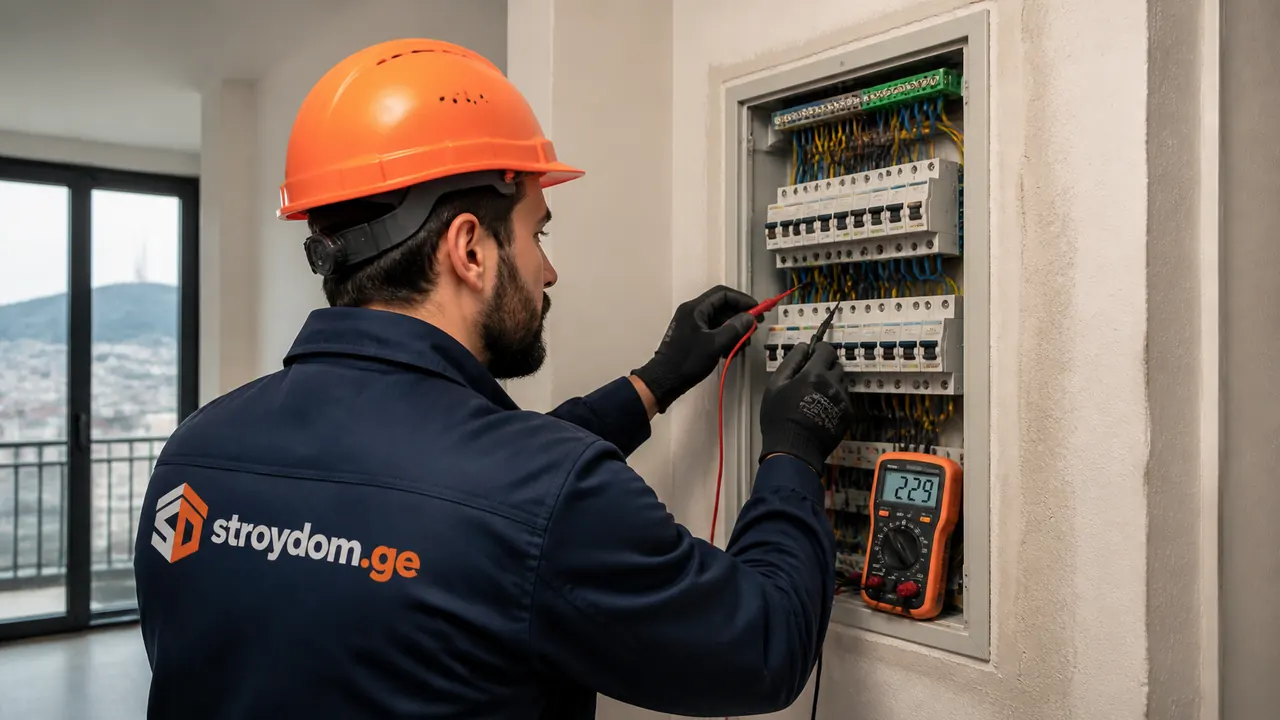
Electrical works
stroydom.ge designs and installs electrical systems in Tbilisi as part of a comprehensive project. A complete point (socket, switch or light with cable) costs 55–85 ₾. A board of 12–24 modules is 600–1200 ₾, 36–54 modules 1500–2800 ₾. LSZH cable 3×2.5 is 8–12 ₾/m, an internet or TV outlet 45–70 ₾. A 60 m² flat with design, board and about 50 points comes to 6500–11,000 ₾ over 2–3 weeks. Advance no more than 15%, prices fixed once the design is agreed.
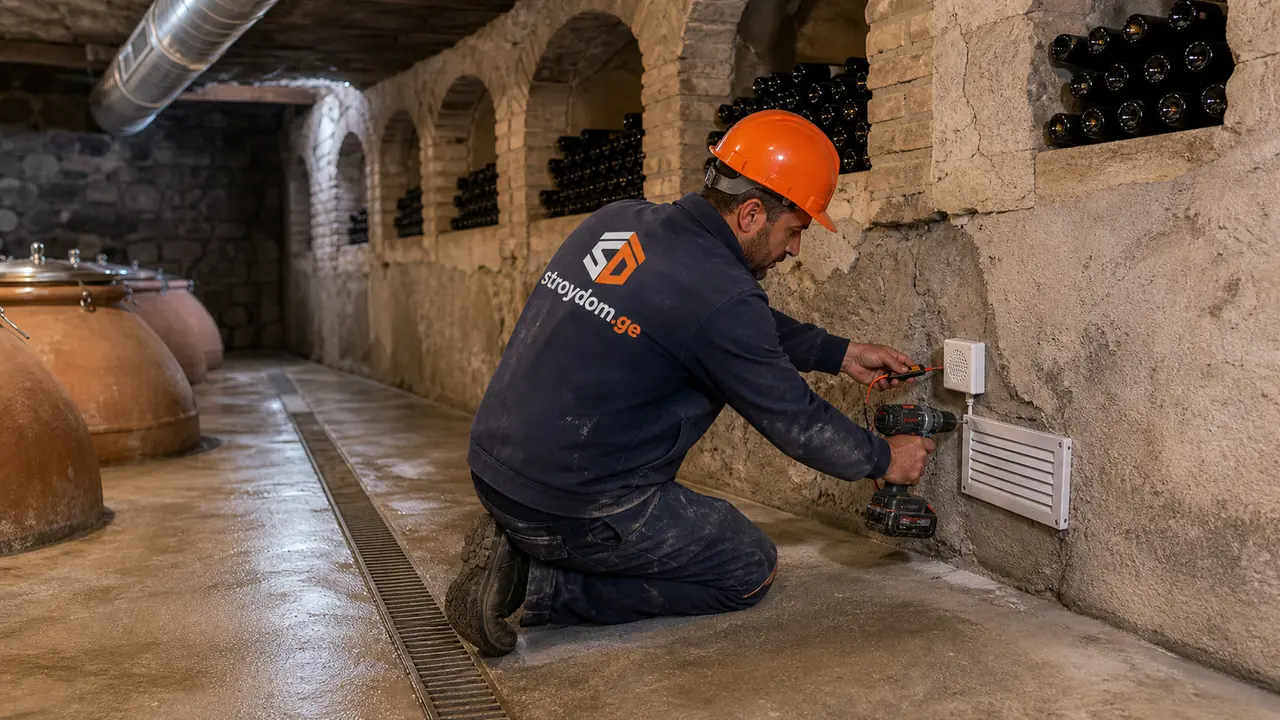
We design and install electrical systems for houses, flats and commercial premises: load calculations, board schematics, cabling, board assembly with breakers and RCDs, accessory fitting and commissioning with measurements. Electrics is the one service where a mistake creates a direct fire risk, so we do not bend the standards even to save the client money.
Only as part of a house project
We deliver this line of work only as part of a house project, when we build the house turnkey. We do not take it as a standalone order: a single warranty is only possible when one contractor answers for the whole chain of work.
About the work
How does stroydom.ge deliver electrical works?
Electrical installation from load calculations to test records: the one system you cannot redo after the finishes are on.
What is included in electrical works?
What is electrical works and why is it needed?
Electrics is the system where mistakes create a direct risk of fire and electric shock, and the one that cannot be redone after moving in: the cable is buried in walls and screed, and reaching it means stripping the finishes throughout the flat. A modern home runs dozens of loads at once: oven, hob, dishwasher, washing machine, dryer, water heater, air conditioners, underfloor heating, car charger. The combined demand easily exceeds 15 kW, and without a calculation those loads cannot be distributed correctly across circuits.
Hence the principle: calculate first, chase second. Heavy loads get dedicated circuits with their own breaker, wet areas get a 10 mA RCD, and the whole installation gets a voltage relay, because in Georgian networks voltage swings are the norm rather than the exception. The second principle is discrimination: breakers are chosen so that a short circuit trips only the affected circuit rather than the whole house.
The third is documentation: every chase is photographed before filling, every core is labelled, and a schematic stays on the board door. Five years later, when someone wants to hang a cabinet or add a circuit, that schematic is worth more than the board itself.
What stages does electrical works consist of?
Each stage runs only after the previous one is accepted — so hidden works are never "closed" before inspection, and a mistake never has to be hunted for through screed and plaster.
- 1
Load calculation
Power demand calculated, cable sizes and breaker ratings selected.
- 2
Design and board schematic
Single-line board schematic, wiring layout and material specification.
- 3
Chasing and routes
Laser setting out, chasing, drilling for back boxes and the board recess.
- 4
Cabling
LSZH cable in conduit, terminated in back boxes to the design.
- 5
Board assembly
DIN rails, main switch, voltage relay, RCBOs and RCDs installed and wired.
- 6
Accessories
After the finishes: sockets, switches, luminaires, dimmers, thermostats.
- 7
Commissioning
Insulation and earth resistance measured, RCDs tested, test records issued.
How does stroydom.ge control quality on site?
How we work on site — materials, equipment, tolerances, documentation and acceptance of hidden works.
Discrimination
A hierarchy of breakers: a fault trips only the affected circuit.
Earthing
Earth electrode, a dedicated protective conductor to every socket, supplementary bonding in bathrooms.
Data cabling
Cat6, coaxial and CCTV cable run alongside power with the required separation.
Labelling
Every core is labelled, and the board door carries the schematic and circuit list.
Documentation
As-built schematic, test records and equipment certificates.
What should be accounted for in Tbilisi and Georgia?
What we account for here: seismic intensity 8 (MSK-64), hot summers and damp winters, steep terrain, older stock with timber floors and worn city networks.
Unstable supply voltage
In Gldani and Varketili the supply swings between 180 and 250 V. We fit an ABB voltage relay and, where needed, a stabiliser.
Old aluminium
In Soviet-era blocks the riser wiring is aluminium. We connect through crimped sleeves or WAGO connectors, never by twisting.
Seismic service entry
The incoming cable is left in a flexible loop with 300 mm of slack for ground movement, and the earth electrode is separate.
Underfloor heating
A dedicated 2.5 mm² circuit with an RCBO. LED lighting runs through dimmers rated for LED loads.
Data cabling and interference
Power and data run in separate chases 50 mm apart or crossing at 90°. Otherwise interference lands on the Cat6 and "the internet is slow" for no visible reason.
Chasing load-bearing walls
In concrete and panel buildings horizontal chases in load-bearing walls are forbidden because they cut structural rebar. We route along the ceiling with vertical drops, even where that is longer and dearer.
How much does it cost and how long does it take?
Indicative price ranges in lari (₾) for standard conditions. The final estimate is fixed after measurements and specification approval.
| Item | What is included and the price |
|---|---|
| Per point | Socket, switch or light point including cable: 55–85 ₾ per point. |
| Distribution board | 12–24 modules — 600–1200 ₾, 36–54 modules — 1500–2800 ₾. |
| Cable | LSZH 3×2.5 — 8–12 ₾/m, 3×4 — 12–16 ₾/m. |
| Data | Internet/TV outlet — 45–70 ₾, Cat6 installation — 6–9 ₾/m. |
| Flat, complete | 60 m² with design, board and about 50 points: 6500–11,000 ₾ over 2–3 weeks. |
| Terms | Prices are fixed once the design is agreed. Advance no more than 15%, the balance by stages. |
Updated:
Ready to estimate?
Leave a request — engineer site visit, measurement and a preliminary estimate for "electrical works" are free.

Planning to build a house?
Start with a free consultation about your plot, floor area and budget. If you are still looking for land, tell us about a plot you are considering.
We will call within an hour, 24/7. You do not need drawings for the first conversation.
By submitting the form you agree to personal data processing. Privacy Policy
Frequently asked questions — Electrical works
How many sockets does a flat or house need?
It is calculated from use, not habit. A living room needs 6–8 points, a kitchen 12–16 with dedicated circuits for the oven, hob and dishwasher, a bathroom 3–4 with a 10 mA RCD. A missing socket later becomes an extension lead, and an extension lead under a rug is the most common domestic cause of fire.
What is an RCD and how does it differ from a breaker?
A breaker protects the cable from overload and short circuit; that is, it protects property. An RCD detects current leaking to earth and protects people: it trips if current passes through a body, where a breaker would not react at all. Wet areas get a 10 mA RCD, other circuits 30 mA.
Why is a voltage relay necessary?
In Gldani, Varketili and parts of the suburbs the supply swings between 180 and 250 V. A relay disconnects the supply outside the safe band and reconnects after a delay. It costs 120–250 ₾ and protects every appliance in the house, while one burnt-out fridge costs more.
Can electrical work be done without a design?
Technically yes, practically no. Without load calculations you cannot choose cable sizes or breaker ratings, and without a wiring plan you cannot later hang a shelf without hitting a cable. We produce a single-line board schematic and a route plan, photograph every chase before it is filled, and hand the as-built schematic to the client.
What should be done with old aluminium wiring?
Aluminium in Tbilisi’s older stock is brittle, oxidises and was never rated for modern loads. Inside the flat we replace it entirely with copper. Where the riser stays aluminium, we make the joint with crimped sleeves or WAGO connectors with paste, because twisting copper to aluminium directly overheats and fails within a year or two.
How long does the electrical work take in a 60 m² flat?
Two to three weeks: a week of chasing and cabling, a few days to build the board, then a pause until the finishes are done and a final visit to fit accessories and commission the system. Accessories go on last, after painting. Otherwise, the faceplates get dirty and scratched.