
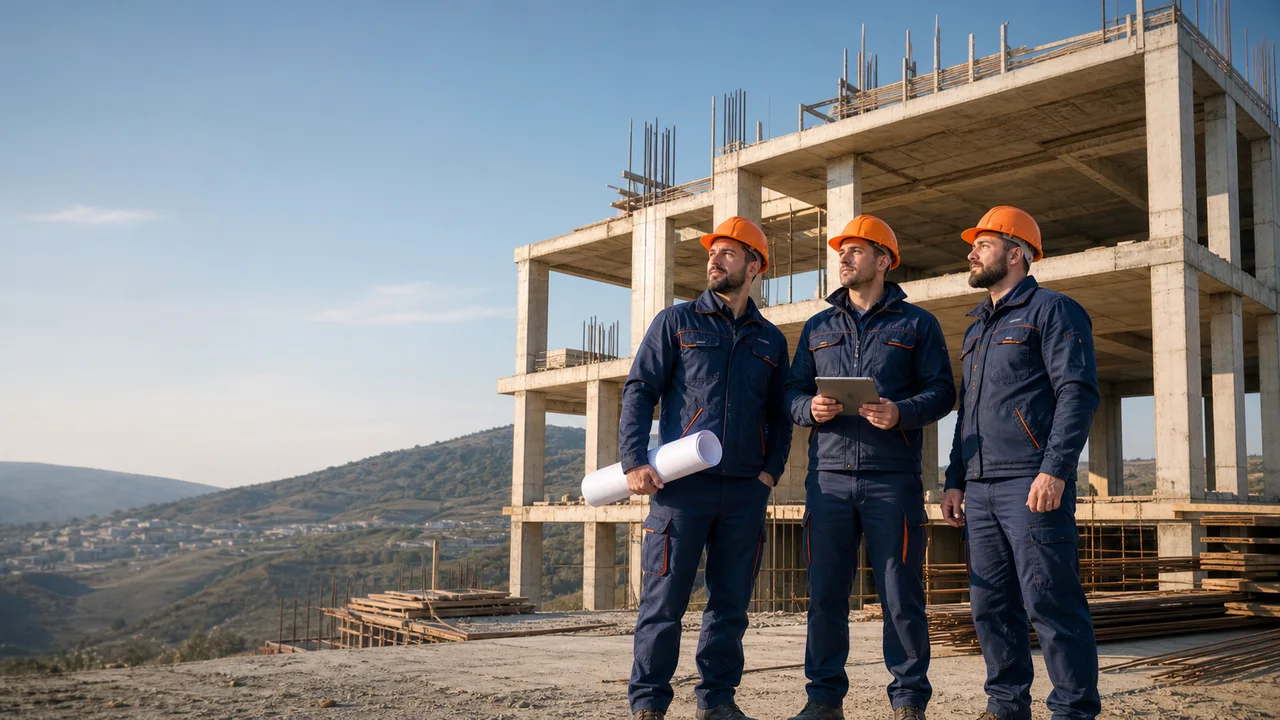
Who is on site
Construction crews in Tbilisi: who will build your house
stroydom.ge comes onto a site in Tbilisi as the main contractor: its own crews, a site manager on site and a contract with a company, not with an individual worker. Beyond the crews’ work, the main contract covers the estimate and procurement, the order of stages, acceptance of hidden works with a photo record and checking quantities before payment. The warranty is written, up to 10 years, and the advance is capped at 15%. Building since 2014, with more than 50 projects handed over.
The question of who exactly turns up on site is rarely asked, yet it shapes the result more than the price per square metre. The difference between hiring a crew directly and contracting a main contractor is not cost but who is answerable when something goes wrong. We set out both options honestly, including when a crew is the better choice.
Crew direct or main contractor: what is the difference?
Who answers for the result
Hire a crew and responsibility for the joints between stages stays with you: the concrete crew hands over, the finishers arrive and find the geometry out of true, and the argument is yours. Under a main contract, the contractor answers for the handover between stages, not the client.
Who counts quantities and materials
A crew prices its own scope; nobody keeps the overall budget or handles procurement. A main contract covers supply, logistics and quantities in full, including what belongs to no single crew.
What happens with defects
Crews rarely give a warranty, and when they do it is verbal. Under a main contract warranty obligations are set out in writing, and putting defects right does not depend on whether a particular individual still works for the company.
Who holds the schedule
Crews work several sites and turn up when they are free. A main contractor sequences the work so the next stage starts as soon as the previous one ends, and is answerable for idle time.
How do crews work on stroydom.ge sites?
- Permanent crews by trade (concrete, roofing, engineering, finishing), not people assembled for one job
- A site manager on site responsible for quality and sequencing, rather than coordinating by phone
- We pay the crews on our own schedule; the client is not involved in settling with workers
- Concealed works are signed off with photographic records before the next stage covers them
- Site safety and access are our responsibility, including liability for incidents
When does hiring a crew directly really make more sense?
- A single small isolated trade: roofing only, or floor screed only
- You live nearby and are ready to be on site daily
- You already have your own site manager or supervisor holding the schedule and quantities
- You are willing to take on procurement and storage of materials
- In every other case, the saving on main contracting is usually eaten by rework
How to choose a contractor to build a house?
Short answer: by the contract, the estimate and the acceptance process, not by the price per square metre. A reliable contractor signs a contract with a fixed line-by-line estimate and a schedule, takes payment for accepted stages rather than the full sum upfront, shows hidden works before they are closed and gives a written warranty. A price well below the market almost always means extra charges along the way or savings on hidden works.
1. Contract and line-by-line estimate
A fixed estimate and schedule in the contract, not verbal promises. Line by line, you see what you pay for. At stroydom.ge the estimate is fixed in the contract in lari.
2. Advance and stage payments
Payment for accepted volumes, not 100% upfront. At stroydom.ge the advance never exceeds 15%, then payments follow accepted stages.
3. Acceptance of hidden works
Ask how rebar, screed, wiring and waterproofing are accepted before the next layer closes them. No clear answer when asked to show acceptance on a past site is a warning sign.
4. Written warranty
A warranty in the contract is the company’s obligation, not an individual worker’s. At stroydom.ge: structure 10 years, roof and facade 5, building services 3, finishes 2 years.
5. Projects of the same type
Look at previous projects of the same type rather than generic photos, and ask who exactly will be the site manager.
6. Reasons not to start
A refusal to sign a contract, a demand for the full sum upfront, no line-by-line estimate, a price well below the market.
What does a main contractor do beyond the crews’ work?
| Item | What is included and the price |
|---|---|
| Budget and procurement | Quantity take-off, purchasing, logistics and storage of materials on site: everything that falls to the client when crews are hired directly. |
| Site manager and sequencing | Constant presence on site, coordination between crews and responsibility for idle time between stages. |
| Inspection and sign-off | Concealed works signed off with photographic records before the next layer covers them, and quantities reconciled against the budget before each stage is paid. |
| Contractual warranty | Written warranty obligations on the completed works: an obligation of the company, not of an individual worker. |
Budget and procurement
Quantity take-off, purchasing, logistics and storage of materials on site: everything that falls to the client when crews are hired directly.
Site manager and sequencing
Constant presence on site, coordination between crews and responsibility for idle time between stages.
Inspection and sign-off
Concealed works signed off with photographic records before the next layer covers them, and quantities reconciled against the budget before each stage is paid.
Contractual warranty
Written warranty obligations on the completed works: an obligation of the company, not of an individual worker.
Updated:

Want to know who will be on your site?
Send a request and we will tell you which crews work on your type of project and how supervision on site is organised.
We will call within an hour, 24/7. You do not need drawings for the first conversation.
By submitting the form you agree to personal data processing. Privacy Policy
Frequently asked questions about crews and contractors
Can I hire a crew from you without a contract for the whole house?
We work under a contract for a scope of works rather than hiring out crews. We take individual stages (concrete, roofing, engineering, finishing) only within a contract for the whole house, so coordinating all the trades is our responsibility.
Is hiring a crew directly cheaper than working with a contractor?
On paper yes, because a crew price excludes procurement, a site manager, supervision and warranty. Those functions do not disappear; they simply move to you. The saving is justified if you are ready to perform them yourself; if not, it usually goes on rework and idle time.
Are your workers employed in-house or is this subcontracting?
We work with permanent crews by trade: concrete, roofing, engineering, finishing. These are not people assembled for one job: we know the teams, we have seen the quality of their work on previous projects and we are answerable for it under contract.
Who is liable if a crew damages something on site or at a neighbour’s?
Under a main contract, we are. The client does not deal with the workers directly and takes no part in settling with them. This is one of the main practical differences from hiring a crew.
How can I tell whether a crew is competent before work starts?
Look at previous projects of the same type rather than generic photos; ask who specifically will be the site manager; check whether concealed works are recorded. If the question "show me the rebar sign-off from your last project" gets no clear answer, that is already a signal.