
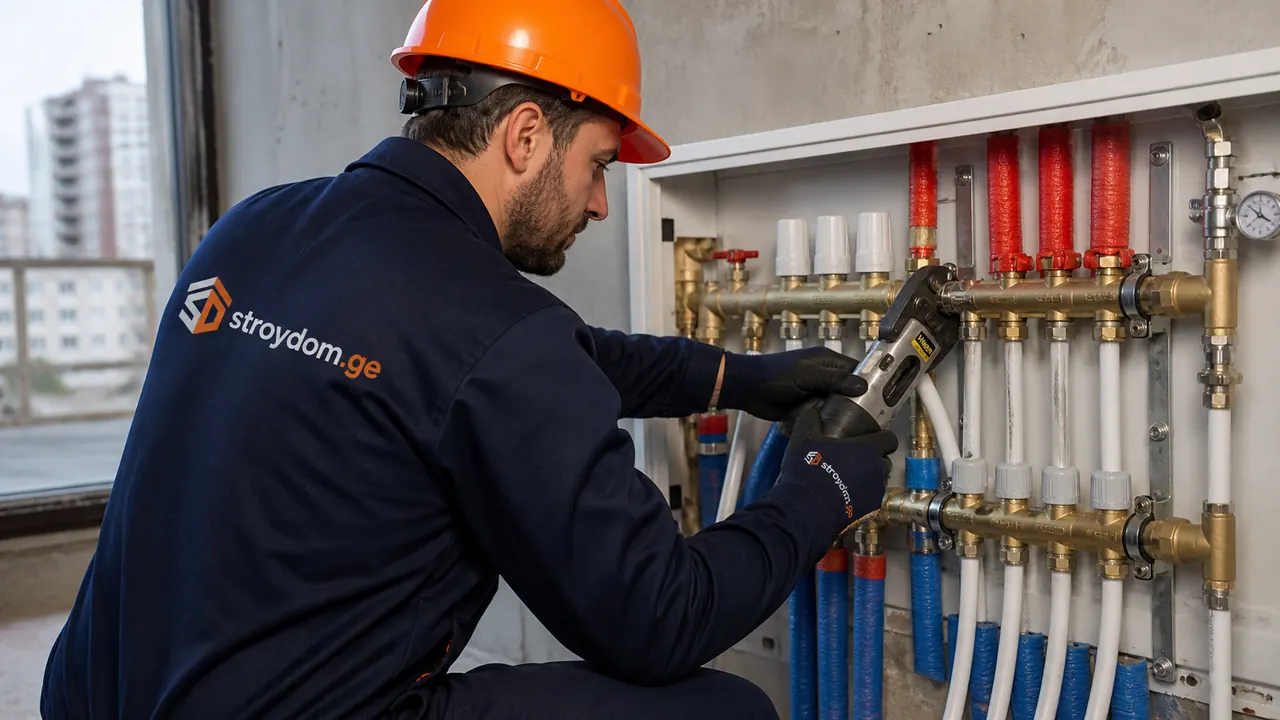
Plot engineering prep
Connecting utilities on a plot in Georgia
stroydom.ge checks utilities on a plot in Georgia before the design starts: electricity, water, sewage and gas. The cost of connection depends on the distance to the nearest networks, the soil the lines run through (earthworks in rock cost more), and the capacity needed for heating, a pool and the number of residents. If there are no networks nearby, stroydom.ge costs an off-grid option: a borehole, a septic tank or a gas tank. The company has worked since 2014, and the contract warranty runs up to 10 years.
A house estimate rarely covers what's outside the house, and connecting to utilities or setting up off-grid systems often turns out to be an unexpected cost line. We check the availability of electricity, water and sewage before the project starts, not once construction is already under way.
What does stroydom.ge check on a plot before the design?
Electricity
Whether there's a substation nearby and the available capacity: for a house with electric heating or air conditioning, capacity headroom matters and is worth checking early, not after buying appliances.
Water supply
A centralised network nearby, or your own well: this determines both the estimate and what equipment goes into the house's engineering design.
Sewage
Central network, septic tank or a local treatment plant: the choice depends on how close the collector is, the soil type and the groundwater level on the plot.
Gas
Not every plot has a gas line nearby. Where there isn't one, we consider electric heating or an off-grid gas tank as an alternative.
What if there are no networks near the plot?
- A water well with a pump station and filtration matched to the local water composition
- A septic tank or local biological treatment plant instead of central sewage
- A gas tank as an alternative to a gas line, for heating and hot water
- A backup generator for plots with unstable electricity supply
- Storage tanks for water in case of interruptions to the centralised supply
What determines the cost of connecting utilities?
| Item | What is included and the price |
|---|---|
| Distance to the nearest network | The further the plot from the connection point, the higher the laying cost, so it is worth checking before buying land, not after. |
| Soil type for laying | Rocky ground increases the cost of digging for pipes and cable compared to soft ground. |
| Off-grid systems instead of networks | A well, septic tank or gas tank is a one-off outlay that can sometimes cost less than a long run of network cable or pipe. |
| Required capacity and volume | Electrical capacity and system throughput are sized for the house's real needs: heating, a pool, number of occupants. |
Distance to the nearest network
The further the plot from the connection point, the higher the laying cost, so it is worth checking before buying land, not after.
Soil type for laying
Rocky ground increases the cost of digging for pipes and cable compared to soft ground.
Off-grid systems instead of networks
A well, septic tank or gas tank is a one-off outlay that can sometimes cost less than a long run of network cable or pipe.
Required capacity and volume
Electrical capacity and system throughput are sized for the house's real needs: heating, a pool, number of occupants.
Updated:

Not sure what's available on your plot?
Send a request and we'll visit the plot, check network availability and work out whether connection or an off-grid solution is more cost-effective.
We will call within an hour, 24/7. You do not need drawings for the first conversation.
By submitting the form you agree to personal data processing. Privacy Policy
Frequently asked questions about utilities on a plot
How do I find out if there's electricity and water on a specific plot?
We check this on a site visit before the house design: the nearest substation and its spare capacity, whether there's a water network or a well is needed. It's the same visit as the terrain and soil assessment, combined into one trip.
What if there's no gas line nearby?
We consider an alternative: electric heating (a heat pump, an electric boiler) or an off-grid gas tank refilled regularly. The choice depends on the house's floor area, the climate and whether upfront cost or seasonal heating cost matters more to you.
Is a well cheaper than connecting to the central water supply?
Depends on the distance to the network: if the plot is far from the water main, a well with a pump station and filtration is often cheaper than a long one-off pipe run. We give an exact calculation after visiting the specific plot.
Do I need a septic tank if there's no central sewage nearby?
Yes, in that case the alternative is a septic tank or a local biological treatment plant. The choice between them depends on soil type, groundwater level and the volume of wastewater. We work this out at the engineering design stage, not after the house is already built.
Can all this be included in the overall construction estimate?
Yes, if the plot check and utility decisions are made upfront, before the house design. Then off-grid systems or network connections are built into the overall schedule and estimate, rather than showing up as unplanned costs during construction.