Heating
Heating in Tbilisi and across Georgia is priced by part at stroydom.ge: a 24 kW gas boiler with pump and safety group costs 1800–2800 ₾, condensing with an indirect cylinder 3500–5500 ₾, a radiator 180–280 ₾ per unit, wet underfloor 55–85 ₾/m². Full heating for a 150 m² house costs 14000–22000 ₾ and takes 3–4 weeks, with a 3-year installation warranty. Heating comes as part of a full house project.
We design and install heating in Tbilisi and across Georgia: gas and electric boiler rooms, radiator circuits, wet and electric underfloor heating, hot-water cylinders and weather-compensated controls. Sizing comes from the building heat loss rather than floor area; circuits are balanced at the manifold and the system is pressure-tested before screed and finishes. Individual pages cover the parts: the plant room under “Gas equipment”, the low-temperature circuit under “Underfloor heating”.
Only as part of a house project
We deliver this line of work only as part of a house project, when we build the house turnkey. We do not take it as a standalone order: a single warranty is only possible when one contractor answers for the whole chain of work.
About the work
How does stroydom.ge deliver heating?
Heating as one system: plant room, radiators, underfloor circuits and controls, designed together rather than assembled piecemeal.
What is included in heating?
Boiler rooms
Boiler selection and installation, piping and automation.
Radiators
Two- and single-pipe systems, radiator installation.
Underfloor heating
Water and electric systems under tile and laminate.
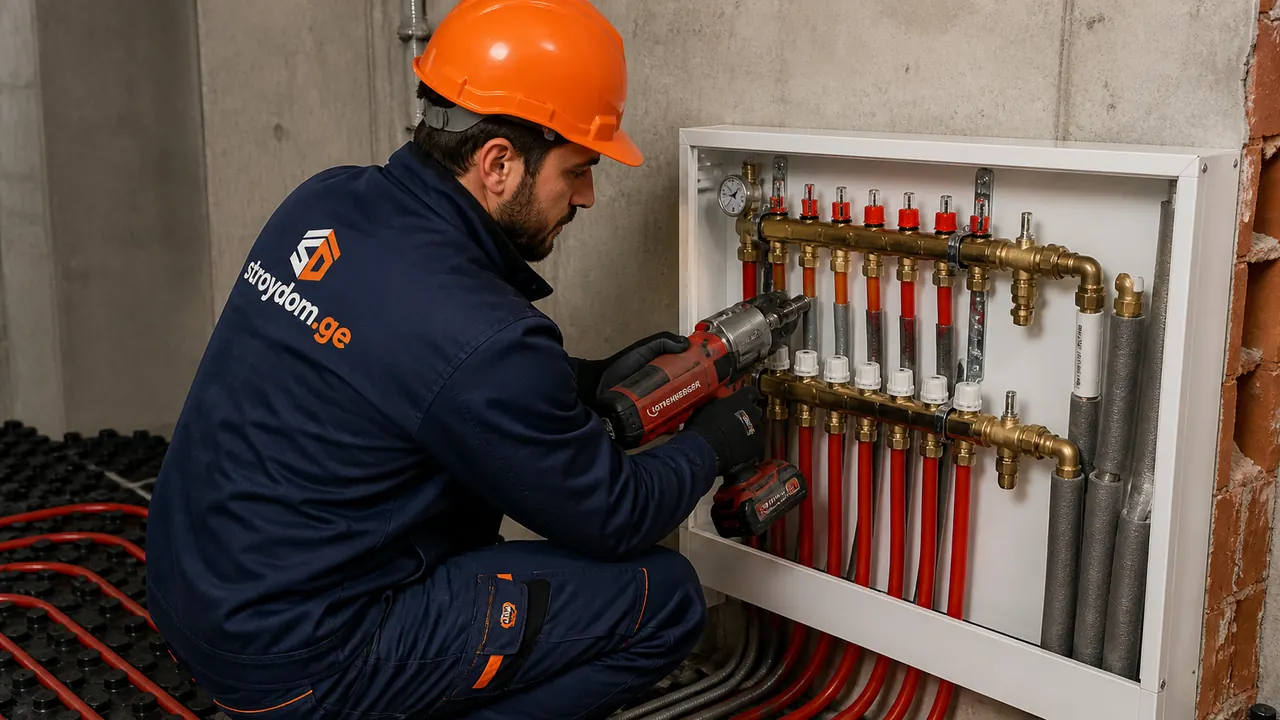
Home-run piping
Every radiator and underfloor loop gets its own pair of pipes back to a manifold, which gives independent control, shutoff and repair without draining the whole system.
Heat pumps
Air-to-water as an alternative to gas or a boiler backup, sized by cost per kilowatt-hour of heat rather than equipment price.
Commissioning
Balancing, testing and system handover.
What is heating and why is it needed?
Heating defines comfort for 5–6 months a year and 50–70% of utility bills. Proper heating means engineering calculation: heat losses, required power, hydraulic balancing. A condensing boiler with weather-dependent automation saves 25–35% gas.
What stages does heating consist of?
Each stage runs only after the previous one is accepted — so hidden works are never "closed" before inspection, and a mistake never has to be hunted for through screed and plaster.
- 1
Thermal calculation
Heat losses per room per code with Tbilisi climate.
- 2
Design
Hydraulic scheme, boiler choice (Vaillant, Bosch, Baxi), manifolds, radiators, pumps.
- 3
Chimney and gas
Coaxial or split chimney choice, coordination with gas service.
- 4
Piping
PEX-A/PEX-B, metal-plastic or copper. Concealed routing in screed for underfloor.
- 5
Radiators and underfloor
Radiator installation with thermostatic heads, underfloor loops with calculated pitch.
- 6
Boiler room
Boiler installation, safety group, pumps, indirect heater, filter, connections.
- 7
Pressure test
6 bar for 24 hours, fill with coolant, bleed air, balance loops, set weather automation.
- 8
Handover
Loaded start-up, owner training, documents and warranty transfer.
How does stroydom.ge control quality on site?
How we work on site — materials, equipment, tolerances, documentation and acceptance of hidden works.
Hydraulic balancing
Each underfloor loop and radiator stack is balanced by flow.
Weather automation
Outdoor sensor and room thermostat adjust supply temperature.
Air protection
Auto air vents in top points, Mayevsky valves, air separator on boiler piping.
Safety
Safety group with relief valve, manometer, expansion tank, gas leak detector with auto shut-off.
Documents
Equipment passports, pressure act, hydraulic scheme, commissioning protocol.
What should be accounted for in Tbilisi and Georgia?
What we account for here: seismic intensity 8 (MSK-64), hot summers and damp winters, steep terrain, older stock with timber floors and worn city networks.
Tbilisi winter
Design temperature −6 °C for Tbilisi, down to −12 °C in Kojori, Tskneti. Sized for the coldest case.
Gas pressure
Drops at peak. For condensing boilers we install a gas pressure stabilizer.
Stone walls
Old stock with 60 cm tuff and brick is thermally massive. Low-temperature mode with underfloor works best.
Power
Gas boiler does not work without electricity. We install a line-interactive UPS with batteries for 4–8 hours.
Underfloor under tile
Water or cable system with thermostat, surface ≤29 °C per code. Under laminate: only certified flooring with compatibility marking.
Home-run piping in the screed
Mandatory for underfloor heating, recommended for radiators in houses with per-room control. The manifold sits somewhere accessible, such as a cabinet or a service niche, and is never buried in a wall.
How much does it cost and how long does it take?
Indicative price ranges in lari (₾) for standard conditions. The final estimate is fixed after measurements and specification approval.
| Item | What is included and the price |
|---|---|
| Boiler room | 24 kW gas boiler with safety group and pump: 1800–2800 ₾. Condensing with indirect heater: 3500–5500 ₾. |
| Radiators | Radiator with connections, valves and head: 180–280 ₾ per unit. Concealed runs in screed: +25–40 ₾/m. |
| Water underfloor | 55–85 ₾/m² finished loop with PEX, manifold and pressure test (no screed and finish). |
| Electric underfloor | Cable mat under tile: 45–65 ₾/m² with thermostat; IR film under laminate: 35–55 ₾/m². |
| Home-run piping | A 6–8 loop manifold with flow meters and actuators: 600–1100 ₾; pipe run to each unit: from 8 ₾/m. |
| Heat pump | Air-to-water 12–16 kW for a 150 m² house: 9000–15000 ₾ installed, not including radiator or underfloor piping. |
| 150 m² house | Full heating (boiler + radiators + underfloor + automation): 14000–22000 ₾, 3–4 weeks. |
| Terms | Prices fixed after thermal calculation. 3-year installation warranty, factory boiler warranty 2–5 years. |
Updated:
Ready to estimate?
Leave a request — engineer site visit, measurement and a preliminary estimate for "heating" are free.

Planning to build a house?
Start with a free consultation about your plot, floor area and budget. If you are still looking for land, tell us about a plot you are considering.
We will call within an hour, 24/7. You do not need drawings for the first conversation.
By submitting the form you agree to personal data processing. Privacy Policy
Frequently asked questions — Heating
Radiators or underfloor heating: which should I choose?
Underfloor heating runs at a low flow temperature (35–45 °C), spreads heat evenly and pairs best with a condensing boiler, saving 25–35% on gas. Radiators respond faster to temperature changes and cost less to install. In practice a combination works best: underfloor heating on the ground floor and in bathrooms, radiators under the windows in bedrooms.
What boiler output do I need?
Not "by floor area" but from a heat-loss calculation. The rule of thumb of 1 kW per 10 m² is a rough guess and almost always oversizes: it ignores wall insulation, glazing area, orientation and ceiling height. An oversized boiler short-cycles, wears out faster and burns more gas than a correctly sized one.
What if there is no gas supply?
In Tbilisi’s suburbs and on new plots gas is not always available. The workable alternatives are an air-to-water heat pump (effective down to −7 °C, which covers a Tbilisi winter), an electric boiler on a night tariff, or a hybrid scheme. Each option is compared on the cost per kilowatt-hour of heat, not on the price of the equipment.
Why does the boiler need protection from power cuts?
A modern gas boiler does not run without electricity: the pump stops, the gas valve stays shut and the controls go dead. A few hours without power in winter means a cooling house and a risk of freezing the circuits. A UPS giving 4–8 hours costs 400–900 ₾ and removes the problem entirely.
Does a heating system need balancing?
Always. Without balancing the water takes the path of least resistance: radiators near the boiler run hot while distant ones stay lukewarm. The owner responds by raising the boiler temperature, pays more for gas and still feels cold in the far room. Flow balancing solves this without a single extra kilowatt.
What surface temperature is allowed for underfloor heating under tile and laminate?
Floor surface temperature must not exceed 29 °C in living areas or 33 °C in bathrooms. Under tile that imposes no limits; under laminate you need boards certified for underfloor heating, no more than 8–10 mm thick, because a thick board acts as insulation and defeats the system.
What is home-run (manifold) piping and why does it matter?
In a home-run scheme each radiator and each underfloor loop gets its own pair of pipes running back to a shared manifold, unlike a series scheme where units are strung one after another on the same line. Home-run costs 15–20% more to install but gives independent control per room, accurate balancing without guessing pipe diameters, and lets you repair one loop without draining the whole system. Underfloor heating is only ever done this way: there it is the standard.
Is a heat pump cheaper to run than a gas boiler in Tbilisi?
With gas available, a condensing boiler almost always gives a lower cost per kilowatt-hour of heat than an air-to-water heat pump. A heat pump wins where gas is physically unavailable (new plots and suburbs without a main line) or where you want heating and cooling from one unit. A COP of 3–4 still beats a direct electric boiler in every case. The real answer only comes from the house’s heat-loss calculation and the site’s actual tariffs.
Is infrared heating worth considering?
Infrared film and panels give fast, waterless heat. They make sense for an attic, a veranda, or topping up one room. As the main heating for a 150+ m² house they cost more to run than a gas boiler with underfloor heating or radiators: electricity in Georgia is not cheap enough to make that pay off on continuous heating.