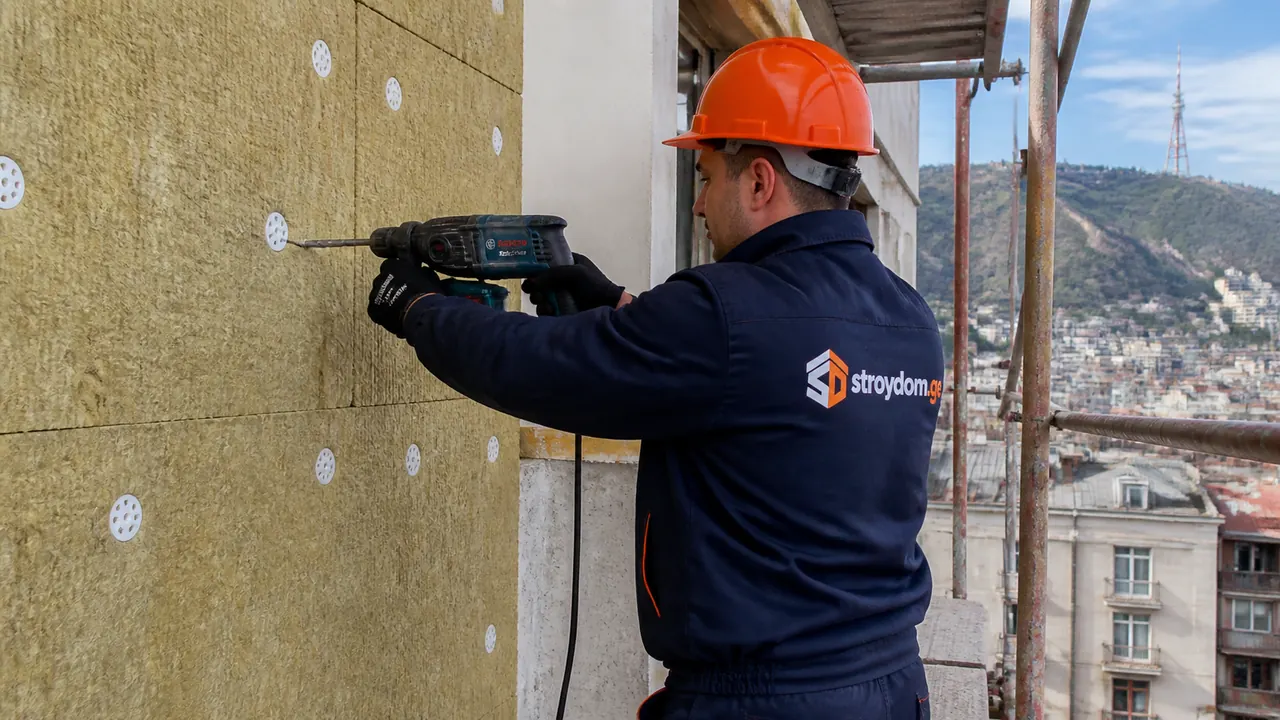
Facade works
stroydom.ge carries out facade works in Tbilisi as part of a comprehensive project. Guide prices before the survey: insulation in mineral wool or EPS with reinforcement costs 45–70 GEL/m² of labour, decorative render 22–35 GEL/m², two coats of facade paint 12–20 GEL/m², a ventilated facade with sub-frame and cladding 85–140 GEL/m². Reveals are 35–60 GEL per linear metre, sills 30–50 GEL/m, crack repair from 18 GEL/m. Scaffold is a separate line at 8–14 GEL/m² per month. The system warranty in the contract is 5 years, with 10 years on the structure in full-cycle work.
We insulate and finish facades on private houses and commercial buildings in Tbilisi: render systems with mineral wool or EPS, ventilated facades on a sub-frame, decorative render, stone and clinker, plus repair and repainting of existing facades.
Only as part of comprehensive projects
We deliver this line of work inside a comprehensive project — building a turnkey house or fitting out a property in full. We do not take it as a standalone order: a single warranty is only possible when one contractor answers for the whole chain of work.
About the work
How does stroydom.ge deliver facade works?
Insulating and finishing facades: protection from heat, water and temperature swings.
What is included in facade works?
Substrate preparation
Cleaning, crack repair, priming, checking the wall can take fixings.
Insulation
Mineral wool or EPS, thickness set by thermal calculation and dew point.
Render system
Reinforcing coat with mesh, base and decorative render, facade paint.
Ventilated facade
Sub-frame, insulation, breather membrane, ventilation gap and cladding.
Details
Reveals, sills, plinth, junctions to the roof, corners and movement joints.
What is facade works and why is it needed?
A facade is not just appearance but a working assembly: it holds the insulation, sheds water and has to let vapour out of the wall. Built wrongly it turns from protection into a problem: water stays inside, insulation gets wet, mould appears on internal walls. That is why a facade starts with a thermal calculation and a system matched to the wall material, not with choosing a colour.
What stages does facade works consist of?
Each stage runs only after the previous one is accepted — so hidden works are never "closed" before inspection, and a mistake never has to be hunted for through screed and plaster.
- 1
Survey
Wall material and condition, cracks, flatness, pull-out capacity for fixings.
- 2
Thermal calculation
Insulation type and thickness, dew point position, vapour permeability of the layers.
- 3
Substrate preparation
Cleaning, repair of cracks and spalls, priming, levelling where needed.
- 4
Insulation
Adhesive over the full plane, plate fixings to a pattern, boards laid staggered.
- 5
Reinforcing coat
Base coat with alkali-resistant mesh, diagonal patches at opening corners, corner beads.
- 6
Details
Reveals, sills, plinth and roof junctions, movement joints.
- 7
Final finish
Decorative render, facade paint, stone or clinker.
- 8
Handover
Geometry and joints checked, photo record of concealed layers, warranty.
How does stroydom.ge control quality on site?
How we work on site — materials, equipment, tolerances, documentation and acceptance of hidden works.
Photo record of concealed layers
Insulation, fixings and mesh are photographed before the base coat goes on.
Fixings to a pattern
Number and length are calculated from wind load and wall material, not taken as usual.
Temperature control
We measure substrate temperature: mixes go on within their working range or they never gain strength.
Scaffold and protection
Scaffold with netting: shade while working and protection for neighbours from spray.
Documents
Material data sheets, concealed works certificate, warranty terms in the contract.
What should be accounted for in Tbilisi and Georgia?
What we account for here: seismic intensity 8 (MSK-64), hot summers and damp winters, steep terrain, older stock with timber floors and worn city networks.
Pumice and aerated block
Vapour-permeable walls get mineral wool. EPS on them traps moisture inside the build-up.
Tbilisi heat
A sunlit wall passes 50 °C. We work the shaded side, in the morning, with the scaffold shaded.
Seismic design
Facade movement joints line up with building joints, and opening corners are reinforced diagonally.
The coast
In Batumi and Kobuleti ventilated facades and vapour-open finishes come first: humidity is year-round.
Plinth
The lowest 30–50 cm is the splash and snow zone, so it gets water-resistant insulation and a drip profile.
How much does it cost and how long does it take?
Indicative price ranges in lari (₾) for standard conditions. The final estimate is fixed after measurements and specification approval.
| Item | What is included and the price |
|---|---|
| Guide prices (Tbilisi, before survey) | The figures below are a working guide for budgeting. The firm estimate follows a site visit and survey: scope, access and substrate condition all move the price. |
| Insulation with reinforcement | Mineral wool or EPS with adhesive, fixings, mesh and base coat: 45–70 GEL/m² (labour). |
| Decorative finish | Textured render: 22–35 GEL/m²; two coats of facade paint: 12–20 GEL/m². |
| Ventilated facade | Sub-frame with insulation and cladding: 85–140 GEL/m² depending on the cladding material. |
| Details and preparation | Reveals: 35–60 GEL per linear metre; sills: 30–50 GEL/m; substrate crack repair: from 18 GEL/m. |
| Scaffold | Hire including erection: 8–14 GEL/m² per month, shown as a separate estimate line. |
| How we price | The estimate follows facade area less openings, itemised into preparation, insulation, reinforcement, finish and details. |
| What drives the price | System type (render or ventilated), insulation type and thickness, substrate condition, building height and architectural complexity. |
| Facade within a house budget | In a turnkey estimate, internal finishes and facade are a major item, fixed before work starts as a separate line. |
| Scaffold and prep | Scaffold hire, sheeting and waste removal are priced separately and up front, not added mid-project. |
| Terms | Fixed estimate in GEL, staged payments, system warranty in the contract (5 years on the facade, 10 years on the structure in full-cycle work). |
Updated:
Ready to estimate?
Leave a request — engineer site visit, measurement and a preliminary estimate for "facade works" are free.

Planning to build a house?
Start with a free consultation about your plot, floor area and budget. If you are still looking for land, tell us about a plot you are considering.
We will call within an hour, 24/7. You do not need drawings for the first conversation.
By submitting the form you agree to personal data processing. Privacy Policy
Frequently asked questions — Facade works
Render system or ventilated facade?
A render (wet) system is cheaper, gives a monolithic surface and suits most private houses. A ventilated facade costs more but has an air gap that carries moisture out of the build-up, so it performs better in the humid coastal climate and on taller buildings. Another argument for ventilated is repairability: a damaged panel is replaced locally, whereas render has to be redone in patches.
Mineral wool or EPS?
It depends on the wall. Pumice block and aerated block are vapour permeable: seal them with EPS and you trap moisture inside the wall, where it accumulates. Those walls need mineral wool, which lets vapour out. EPS is justified on concrete and brick, and at the plinth where water resistance matters. Getting this wrong shows up two or three seasons later as damp and mould on internal walls.
How thick should insulation be in Tbilisi?
Thickness follows a thermal calculation for the specific house: wall material and thickness, glazing area, heating regime. There is no universal figure, but the principle is constant: insulation must move the dew point outside the loadbearing wall. In Tbilisi insulation also works against heat: in summer it cuts the cooling load as much as it cuts heating in winter.
Why do facades crack?
Three usual causes: movement of the substrate (settlement or seismic action), missing or badly lapped reinforcing mesh, and breaking the method statement (working in frost, heat or on a wet substrate). Mesh is laid diagonally at opening corners: cracks most often start from window corners. In a seismic area facade movement joints follow the building joints, otherwise the facade cracks wherever it likes.
When can facade work not be done?
Renders and adhesives have a temperature range, usually +5 to +30 °C, and that is substrate temperature, not air. A Tbilisi summer wall in the sun exceeds 50 °C, so the mix dries before it gains strength; we work the shaded elevation, early in the day, or shade the scaffold. Work never proceeds on a wet wall after rain or in frost.
Can a house be insulated from the inside instead?
Technically yes, but it is almost always the worst option: the dew point moves into the build-up, the wall freezes and condensation collects where insulation meets wall. You also lose floor area. Internal insulation is only justified where the facade cannot be touched, for instance on a listed building.