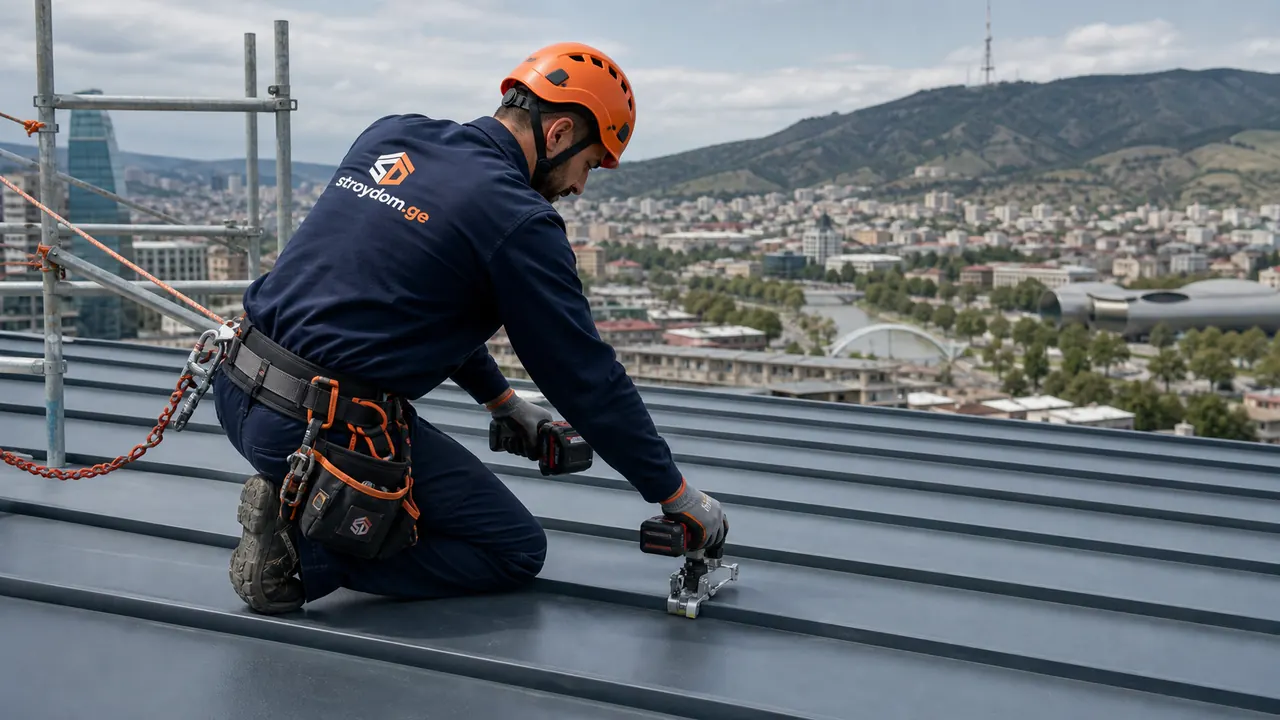
Roofing
Roofing in Tbilisi and across Georgia is priced by roof area at stroydom.ge, line by line: rafter structure 35–55 GEL/m², build-up with vapour barrier and insulation 18–28 GEL/m², covering (metal tile 22–35 GEL/m², bitumen shingles 30–48 GEL/m², standing seam 45–70 GEL/m², PVC membrane on a flat roof 28–45 GEL/m²). Gutters cost 25–40 GEL per linear metre, stripping the old covering 12–22 GEL/m², a local detail repair from 250 GEL. The estimate is fixed in GEL after a survey, paid in stages, with a 5-year warranty on the roof and 10 years on the structure in full-cycle work. Within a turnkey house the shell and roof sit in the per-m² rate.
We build and repair roofs on private houses and commercial buildings in Tbilisi and across Georgia: rafter structure, vapour barrier and insulation, metal tile, standing seam, bitumen shingles, flat roofs with PVC membrane, gutters and snow guards.
Only as part of comprehensive projects
We deliver this line of work inside a comprehensive project — building a turnkey house or fitting out a property in full. We do not take it as a standalone order: a single warranty is only possible when one contractor answers for the whole chain of work.
About the work
How does stroydom.ge deliver roofing?
Pitched and flat roofs, from the rafter structure to the gutters.
What is included in roofing?
Rafter structure
Sections calculated for snow and wind load, timber treatment, installation.
Roof build-up
Vapour barrier, insulation, ventilation gap and breather membrane in the right order.
Covering
Metal tile, standing seam, bitumen shingles, profiled sheet, PVC membrane.
Gutters and junctions
Gutters, outlets, valleys, junctions to pipes and walls, snow guards.
Roof repair
Finding the real cause of a leak, then local repair or full replacement.
What is roofing and why is it needed?
The roof is the most loaded assembly in a house: it takes all the water, snow, wind and UV, and at the same time has to let vapour out from inside. A mistake here costs more than almost anywhere else: a leak ruins insulation, structure and the finishes on the floor below, and reaching the cause after fit-out is hard. That is why we calculate the roof before installation, for the loads of the specific location, and build it as a single system where every layer has a job.
What stages does roofing consist of?
Each stage runs only after the previous one is accepted — so hidden works are never "closed" before inspection, and a mistake never has to be hunted for through screed and plaster.
- 1
Survey and calculation
Geometry measured, snow and wind load by location, rafter sections.
- 2
Covering and details
Material chosen for pitch, climate and budget; valley, junction and gutter layout.
- 3
Rafter structure
Wall plate, rafters, battens. Kiln-dried timber, treated against rot.
- 4
Vapour barrier
Continuous internal layer with taped laps and junctions to walls.
- 5
Insulation and ventilation
Mineral wool between rafters, breather membrane, counter battens for airflow.
- 6
Covering
Laid from the eaves, concealed fixings, trims, ridge ventilation.
- 7
Gutters and safety
Gutters falling to outlets, snow guards, roof guard rails.
- 8
Handover
Junctions checked, valleys flood-tested, photo record of concealed layers.
How does stroydom.ge control quality on site?
How we work on site — materials, equipment, tolerances, documentation and acceptance of hidden works.
Photo record of concealed layers
Vapour barrier, insulation and ventilation gap photographed before the covering goes on.
Concealed fixings where possible
Every penetration through the covering is a potential leak in 5–7 years.
Junctions detailed separately
Pipes, roof windows and walls follow a drawing with flashings, not sealant by eye.
Safety
Harness systems and edge protection: no height work starts without them.
Documents
Material data sheets, concealed works certificate, warranty terms in the contract.
What should be accounted for in Tbilisi and Georgia?
What we account for here: seismic intensity 8 (MSK-64), hot summers and damp winters, steep terrain, older stock with timber floors and worn city networks.
Tbilisi downpours
A summer storm produces peak run-off within minutes. Gutter sizes and outlet numbers are calculated from roof area, not from habit.
Mountains: snow and ice
Gudauri, Bakuriani, Kazbegi: stronger rafters, snow guards, steeper pitches and eaves ventilation against ice dams.
Coast: salt and moisture
Batumi, Kobuleti, Gonio: high corrosion resistance for covering and fixings, otherwise rust within two or three seasons.
Seismic design
The wall plate is anchored to the ring beam and rafter joints work in shear, not just under compression.
Flat roofs on new builds
Tapered falls, two outlets, upstands above 30 cm. The membrane is welded, not glued.
How much does it cost and how long does it take?
Indicative price ranges in lari (₾) for standard conditions. The final estimate is fixed after measurements and specification approval.
| Item | What is included and the price |
|---|---|
| Guide prices (Tbilisi, before survey) | The figures below are a working guide for budgeting. The firm estimate follows a site visit and survey: scope, access and substrate condition all move the price. |
| Rafter structure | 35–55 GEL/m² of roof area for labour with client-supplied timber; materials supplied by us are priced separately. |
| Roof build-up | Vapour barrier, insulation and breather membrane: 18–28 GEL/m² for the assembled layer. |
| Covering | Metal tile and profiled sheet: 22–35 GEL/m²; bitumen shingles: 30–48 GEL/m²; standing seam: 45–70 GEL/m²; PVC membrane on flat roofs: 28–45 GEL/m² (installation). |
| Gutters and trims | Gutters and downpipes: 25–40 GEL per linear metre; snow guards: 30–50 GEL/m; valleys and junctions: 35–60 GEL/m. |
| Strip-out and repair | Removing the old covering: 12–22 GEL/m²; local detail repair: from 250 GEL after a survey. |
| How we price | The estimate follows roof area, itemised into rafter structure, build-up, covering, gutters and trims as separate lines. |
| What drives the price | Pitch and geometry (valleys, windows, pipes), covering material, insulation thickness, working height and how hard materials are to lift. |
| Roofing within a house budget | In a turnkey house estimate, the shell with roof runs 500–700 GEL/m² of total house area. Roofing is a separate line, fixed before work starts. |
| Repair and survey | A site visit with a roof survey and leak diagnosis comes before you sign an estimate, so you know the scope before spending. |
| Terms | Fixed estimate in GEL, staged payments, installation warranty in the contract: 5 years on the roof, 10 years on the structure in full-cycle work. |
Updated:
Ready to estimate?
Leave a request — engineer site visit, measurement and a preliminary estimate for "roofing" are free.

Planning to build a house?
Start with a free consultation about your plot, floor area and budget. If you are still looking for land, tell us about a plot you are considering.
We will call within an hour, 24/7. You do not need drawings for the first conversation.
By submitting the form you agree to personal data processing. Privacy Policy
Frequently asked questions — Roofing
Which covering suits a house in Tbilisi?
For a pitched roof in Tbilisi and the suburbs, metal tile is the usual choice because it is cheaper and faster to install. Standing seam steel with a polymer coating costs more but has no screw penetrations, which makes it safer on shallow pitches from 12° and in driving rain. Bitumen shingles pay off on complex geometry with many valleys and junctions, where sheet metal produces too many cuts and seams.
How does a flat roof differ in use?
A flat roof does not shed water by slope. It holds it until the outlets, so membrane quality and junctions decide everything. A 1.5–3% fall is formed by a tapered layer, at least two outlets are installed (main and emergency), and every vertical is upstood 30 cm above the covering. An error in any of the three leaks in the first heavy rain.
Why does a roof leak after the rain rather than during it?
That is the classic sign of condensation, not a leak. Warm humid air from the house passes through a leaky vapour barrier, reaches the cold steel and condenses on its underside. Water drips onto the insulation, which gets wet and stops working. Replacing the covering will not fix it: the vapour barrier and ventilation gap have to be restored.
What is the snow load in the Georgian mountains?
Tbilisi sees little snow; Gudauri, Bakuriani and Stepantsminda do not. Design snow loads there are many times higher, and rafters sized for Tbilisi simply fold. For high altitude we increase sections, reduce rafter spacing, always fit snow guards and use steeper pitches so snow slides off instead of accumulating.
How long does a roof last on the coast?
In Batumi, Kobuleti and Gonio a roof takes 2000+ mm of rain a year plus salt air, and ordinary galvanised steel corrodes far faster than in Tbilisi. Here you need steel with a high-durability polymer coating or aluminium, with all fixings and trims in stainless steel. Saving on fixings shows as rust streaks within two or three seasons.
Can a roof be repaired instead of replaced?
Often yes. If the covering is sound but water comes in at a pipe junction, a valley or through failed sealant, a local repair makes sense: open the detail, trace the real water path and rebuild it. Full replacement is needed when the covering has lost its geometry, corrosion is through-thickness across the area, or the insulation is soaked and compacted.