
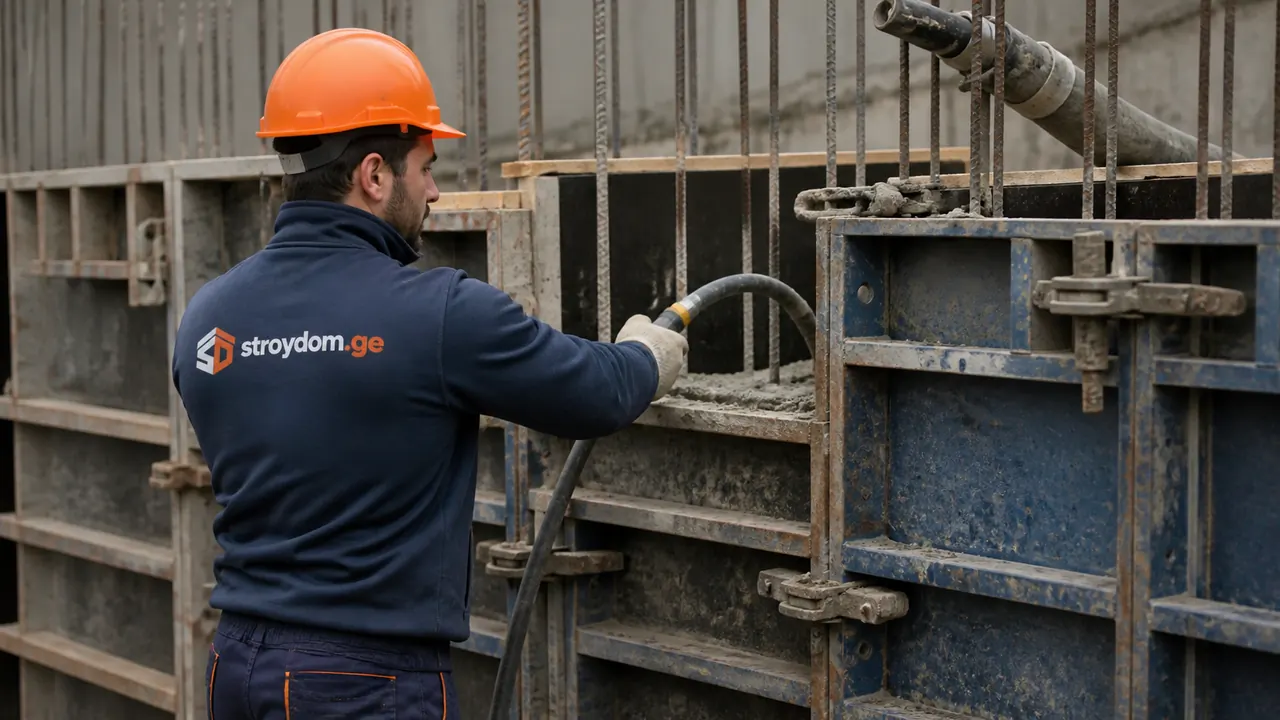
Difficult terrain
Building a house on a slope in Tbilisi
stroydom.ge builds houses on slopes in Tbilisi: in Bagebi, Tsavkisi, Kojori and Tskneti. Groundworks on a slope add 15–40% to the house budget. Bored piles cost 180–320 GEL per linear metre, a monolithic retaining wall 750–1,400 GEL per m² of wall surface, earthworks with removal 25–60 GEL per m³, drainage and stormwater 90–160 GEL per linear metre of circuit. stroydom.ge names the exact figure after the geotechnical survey and before the contract is signed.
Plots with a view are almost always on a slope. That is both their main advantage and the main source of budget overruns: half the money can disappear into the ground if the terrain was not costed before purchase. We build on the slopes of Bagebi, Tsavkisi, Kojori and Tskneti, and we cost the groundworks before you pay a deposit on the plot.
Why does a slope cost more than a flat plot?
The difference is not in building the house, but in what happens underneath it. On a flat plot the foundation is 8–12% of the budget; on a slope, groundworks together with soil retention reach 25–35%.
Retaining the soil
The slope has to be stopped: retaining walls on bored piles ⌀300–500 mm anchored below the slip plane. An ordinary wall on a pad slides down a clay slope together with the soil.
Water
Water runs down the slope and pushes against structures. Wall and layer drainage, storm drains and discharge off site are required, otherwise the basement is damp by the second season.
Earthworks
Cutting into a slope means hauling soil away, and on a narrow street in an old district a tipper cannot turn around. Logistics can cost more than the excavation itself.
Machinery access
A mixer and concrete pump physically have to reach the site. Where they cannot, we work with a manipulator and mini-machinery, which is slower and costlier.
What does stroydom.ge check before you buy the plot?
A site visit with an engineer before the deal costs less than one rebuilt foundation. We give a verdict on your specific plot, not general talk about "difficult terrain".
- Geology: soil type, depth to rock, groundwater level, signs of landslide activity
- Assessment of the height difference and earthworks volume: how many cubic metres to remove and where to
- Slope retention scheme with indicative costs: piles, retaining walls, terracing
- Access check: can a mixer get through, where a crane would stand, is there room to store materials
- Land category, encumbrances and the buildable footprint permitted by regulations
How does stroydom.ge build on a slope?
Pile and grade-beam foundation
Bored piles bearing on dense strata with a monolithic grade beam. The house rests on stable ground, not on the mobile surface layer.
Retaining walls
Monolithic reinforced concrete, reinforced per overturning and sliding calculations, with a filter layer and drainage pipe behind the wall.
Terracing
Several levels instead of one tall wall. Cheaper, more stable, and it produces ready platforms for the yard, parking and seating areas.
Waterproofing and drainage
Two layers of coating and membrane waterproofing on the below-ground structure, perimeter wall drainage, discharge into a collector or soakaway.
Seismic design
Tbilisi is a seismic zone 8 area, and on a slope seismic and landslide loads combine. The frame is calculated for their joint action and the joints are strengthened.
In which Tbilisi districts does stroydom.ge build on slopes?
- Bagebi and Tskneti: steep slopes, rock close to the surface, cutting and retaining walls required
- Tsavkisi and Kojori: significant height differences, clay soils, drainage and surface water discharge are critical
- Upper Vake and Saburtalo: dense development, narrow access, machinery restrictions
- Mtatsminda and Sololaki: historic buildings, close neighbours, mini-machinery and approvals
What do groundworks on a slope cost?
| Item | What is included and the price |
|---|---|
| Bored piles | 180–320 GEL per linear metre depending on diameter and soil. Depth is set by geology, not by what the neighbour did. |
| Retaining wall | 750–1,400 GEL per m² of wall surface including reinforcement, waterproofing and drainage. Height and loads come from calculations. |
| Earthworks and haulage | 25–60 GEL per m³ including removal. The spread is driven by logistics: on narrow streets the price sits at the top of the range. |
| Drainage and water discharge | 90–160 GEL per linear metre of circuit including filter backfill and inspection chambers. |
| Premium over a flat plot | Groundworks on a slope typically add 15–40% to the total house budget. The exact figure comes after geology, before the contract is signed. |
Bored piles
180–320 GEL per linear metre depending on diameter and soil. Depth is set by geology, not by what the neighbour did.
Retaining wall
750–1,400 GEL per m² of wall surface including reinforcement, waterproofing and drainage. Height and loads come from calculations.
Earthworks and haulage
25–60 GEL per m³ including removal. The spread is driven by logistics: on narrow streets the price sits at the top of the range.
Drainage and water discharge
90–160 GEL per linear metre of circuit including filter backfill and inspection chambers.
Premium over a flat plot
Groundworks on a slope typically add 15–40% to the total house budget. The exact figure comes after geology, before the contract is signed.
Updated:

Have a plot on a slope?
Leave your contact and we will visit, assess the terrain and soil and cost the groundworks before you commit to the plot.
We will call within an hour, 24/7. You do not need drawings for the first conversation.
By submitting the form you agree to personal data processing. Privacy Policy
Frequently asked questions about building on a slope
How much more expensive is building on a slope?
Groundworks typically add 15–40% to the house budget compared with a flat plot. The spread is wide because geology decides everything: on rock the piles are short and cheap, on a clay landslide-prone slope you have to go deep and add retaining walls. So we cost your specific site rather than an average.
Can you assess a plot before I buy it?
Yes, and it is the most useful money you will spend on the whole project. We visit with an engineer, assess the height difference, soil, machinery access and signs of movement, and order geology if needed. The output is an indicative groundworks cost. Sometimes our answer is "do not buy this plot", and that saves tens of thousands of GEL.
What foundation is needed on a slope?
In most cases a pile and grade-beam foundation: bored piles ⌀300–500 mm bearing on dense strata with a monolithic beam. A strip foundation only works on a gentle slope with stable soil. A raft is rarely used and needs serious ground preparation. The type follows geology, not budget.
Are retaining walls always necessary?
Almost always where there is a cut into the slope or a height difference over about 1.5 m. The question is the design: sometimes terracing with several low levels is enough, which is cheaper and more stable than one tall wall. The decision comes from overturning and sliding calculations, not from eyeballing it.
What happens if we save on drainage?
Water from the slope pushes against retaining walls and the below-ground structure. Without drainage the wall takes hydrostatic loads it was not designed for, the basement becomes damp, and ground movement is possible in spring. Drainage is 3–5% of the budget; skipping it leads to repairs comparable to the cost of the groundworks.
How long do groundworks on a slope take?
Two to four months depending on earthworks volume, number of piles and weather. In winter below +5 °C concrete works require antifreeze admixtures and heating, which adds to both schedule and cost. We build that into the programme in advance rather than announcing it later.