Landscaping and site works
stroydom.ge carries out landscaping and site works in Tbilisi and across Georgia as a standalone order or as part of a turnkey house. Guide prices before the survey: a reinforced concrete retaining wall costs 380–650 GEL/m² of face, gabion 220–420 GEL/m². Block paving is 35–60 GEL/m² of labour, a concrete slab 45–75 GEL/m². Fencing is 90–180 GEL per linear metre, a sliding gate with automation from 2500 GEL. Channel drains cost 45–80 GEL/m, aprons 55–90 GEL/m. Soil removal and plant hire are priced at the start.
We landscape private plots in Tbilisi and across Georgia: cast and gabion retaining walls on slopes, fences and gates, paved paths and parking areas, storm drainage and aprons, outdoor lighting, irrigation and planting.
Available as a separate order from 1,000 GEL
We take this work as a standalone order from 1,000 GEL, or as part of a turnkey house project. Inside a house project one contractor answers for the whole chain of work: one estimate and one warranty.
About the work
How does stroydom.ge deliver landscaping and site works?
Everything around the house: retaining walls, paving, drainage, lighting.
What is included in landscaping and site works?
Retaining walls
Cast, block and gabion walls designed against overturning, with drainage behind.
Fences and gates
Foundations, posts, panels, sliding and swing gates with automation.
Paths and parking
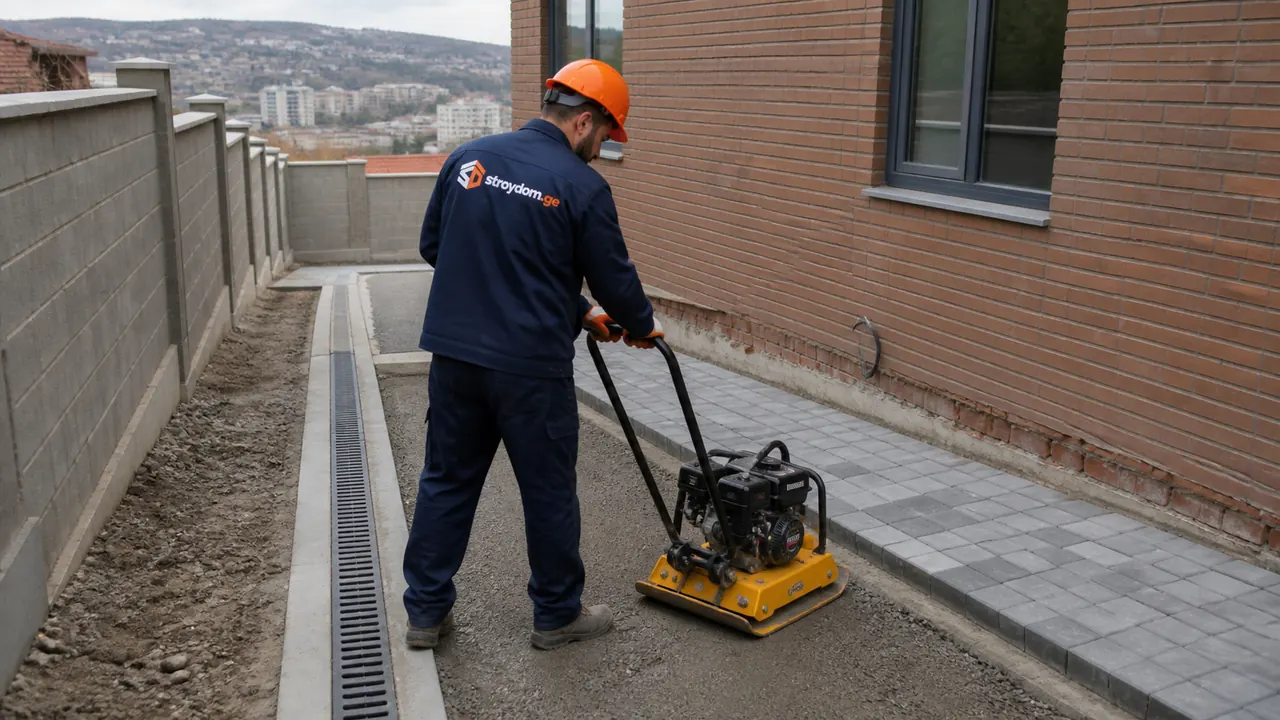
Compacted base, kerbs, block paving, concrete or stone.
Drainage
Channels, gullies, apron and site levels falling away from the house.
Lighting and planting
External circuits in conduit, luminaires, irrigation, lawn and planting.
What is landscaping and site works and why is it needed?
Landscaping is not about laying a pretty lawn but about managing water and soil around the house. This is where it is decided whether the foundation floods, whether the slope moves and whether the parking subsides. So we start with levels and drainage, and put paving, lighting and planting on top of an engineering problem that is already solved.
What stages does landscaping and site works consist of?
Each stage runs only after the previous one is accepted — so hidden works are never "closed" before inspection, and a mistake never has to be hunted for through screed and plaster.
- 1
Survey and layout
Levels, height differences, cadastral boundaries, water and power connection points.
- 2
Level design
Falls away from the house, drainage layout, positions of channels and chambers.
- 3
Earthworks
Excavation, grading, removal of surplus soil, fill and compaction.
- 4
Retaining walls and foundations
Design, reinforcement, concreting, drainage behind the wall with an outlet.
- 5
Buried services
Irrigation, external lighting, gate cable and drainage pipes go in before paving.
- 6
Paving
Base compacted in layers, kerbs, block paving, stone or concrete.
- 7
Lighting and irrigation
Luminaires, external distribution board, irrigation controller.
- 8
Planting
Topsoil, lawn, planting, gravel finishes and final clean-up.
How does stroydom.ge control quality on site?
How we work on site — materials, equipment, tolerances, documentation and acceptance of hidden works.
Water first, looks second
Levels and drainage are designed before anyone picks the colour of the paving.
Compaction in layers
The base is compacted in 10–15 cm layers: otherwise settlement is guaranteed whatever the paving.
Drainage behind retaining walls
Without it the wall takes water pressure it was never designed for.
Services before paving
Every forgotten pipe or cable means a path opened up a month later.
Photo record
Bases, wall reinforcement and service routes are photographed before they are covered.
What should be accounted for in Tbilisi and Georgia?
What we account for here: seismic intensity 8 (MSK-64), hot summers and damp winters, steep terrain, older stock with timber floors and worn city networks.
Tbilisi slopes
In Vake, Saburtalo and the suburbs a 2–5 m level difference across a plot is normal. Retaining walls are structure here, not decoration.
Clay soils
Water does not soak away, it stands. Drainage and storm water routing are mandatory or the plinth floods.
Seismic design
Tall retaining walls are reinforced and tied to their foundation: unreinforced masonry folds in a tremor.
Summer heat
Concrete and mortar set faster than normal: we work early, then cover and keep surfaces damp.
Heavy machinery
Excavator and mixer access is planned in advance: once paving is down, machinery cannot come back in.
How much does it cost and how long does it take?
Indicative price ranges in lari (₾) for standard conditions. The final estimate is fixed after measurements and specification approval.
| Item | What is included and the price |
|---|---|
| Guide prices (Tbilisi, before survey) | The figures below are a working guide for budgeting. The firm estimate follows a site visit and survey: scope, access and substrate condition all move the price. |
| Retaining walls | Reinforced concrete wall with drainage behind: 380–650 GEL/m² of face; gabion: 220–420 GEL/m². |
| Paving | Compacted base and block paving: 35–60 GEL/m² (labour); concrete slab: 45–75 GEL/m². |
| Fencing | Foundations, posts and panels: 90–180 GEL per linear metre of labour; sliding gate with automation: from 2500 GEL. |
| Drainage | Channel drains: 45–80 GEL/m; apron around the house: 55–90 GEL per linear metre. |
| Lighting and irrigation | External circuits in conduit: 22–38 GEL/m; irrigation: 12–20 GEL/m² of lawn. |
| How we price | The estimate splits into earthworks, retaining walls, paving, drainage, lighting and planting as separate sections. |
| What drives the price | Level differences and volume of earthworks, height and type of retaining walls, paved area and material, machinery access. |
| Within a house budget | On turnkey projects landscaping, fencing and paths are a separate estimate line fixed before work starts. |
| Priced up front | Soil removal, plant hire and fill are calculated at the start, not added halfway through. |
| Terms | Fixed estimate in GEL, staged payments, structural warranty in the contract (10 years on full-cycle work). |
Updated:
Ready to estimate?
Leave a request — engineer site visit, measurement and a preliminary estimate for "landscaping and site works" are free.

Planning to build a house?
Start with a free consultation about your plot, floor area and budget. If you are still looking for land, tell us about a plot you are considering.
We will call within an hour, 24/7. You do not need drawings for the first conversation.
By submitting the form you agree to personal data processing. Privacy Policy
Frequently asked questions — Landscaping and site works
Why can a retaining wall not be copied from the neighbour?
A retaining wall holds back not only soil but the water in it: after heavy rain the pressure multiplies. A wall is designed against overturning and sliding for the specific slope, height and soil type, and drainage behind it with an outlet is mandatory. Walls built without calculation and drainage are the most common cause of collapses on the slopes of Vake, Saburtalo and the Tbilisi suburbs.
What do you do with storm water on a plot?
The first rule is that water moves away from the house, not towards it: site levels give a 2–3% fall from the plinth. Water is then collected by channels and gullies and taken to a soakaway, ditch or storm sewer. Tbilisi clay soils barely absorb water, so without organised drainage it stands at the foundation and floods the basement.
What base do paths and parking need?
A footpath needs 10–15 cm of compacted crushed stone plus bedding. Parking for a car needs 20–25 cm compacted in layers, with geotextile on weak soils. If the base is not compacted layer by layer, the paving ruts in the first season and redoing it costs more than building it correctly.
When should landscaping be done?
After the heavy construction but before internal finishes, so that machinery and deliveries do not wreck new paving. All buried services (irrigation, lighting, drainage, the cable to the gate) go in before paving. The most expensive mistake is paving the plot and remembering the gate cable a month later.
Does a fence need to be agreed with neighbours?
Boundaries follow the cadastre and the fence goes strictly on your side. In Georgia boundary disputes are settled by cadastral survey, so before work we ask for the land documents and, where needed, have a surveyor set out the boundary. That is cheaper than moving a finished fence after a complaint.
What about planting in the Tbilisi climate?
Summers reach +40 °C with months without rain, so a lawn without irrigation burns out. Either an irrigation system with a timer is installed, or drought-tolerant species and surfaces are chosen (gravel, local plants, ornamental grasses). This is decided before paving, because irrigation pipes run underneath.