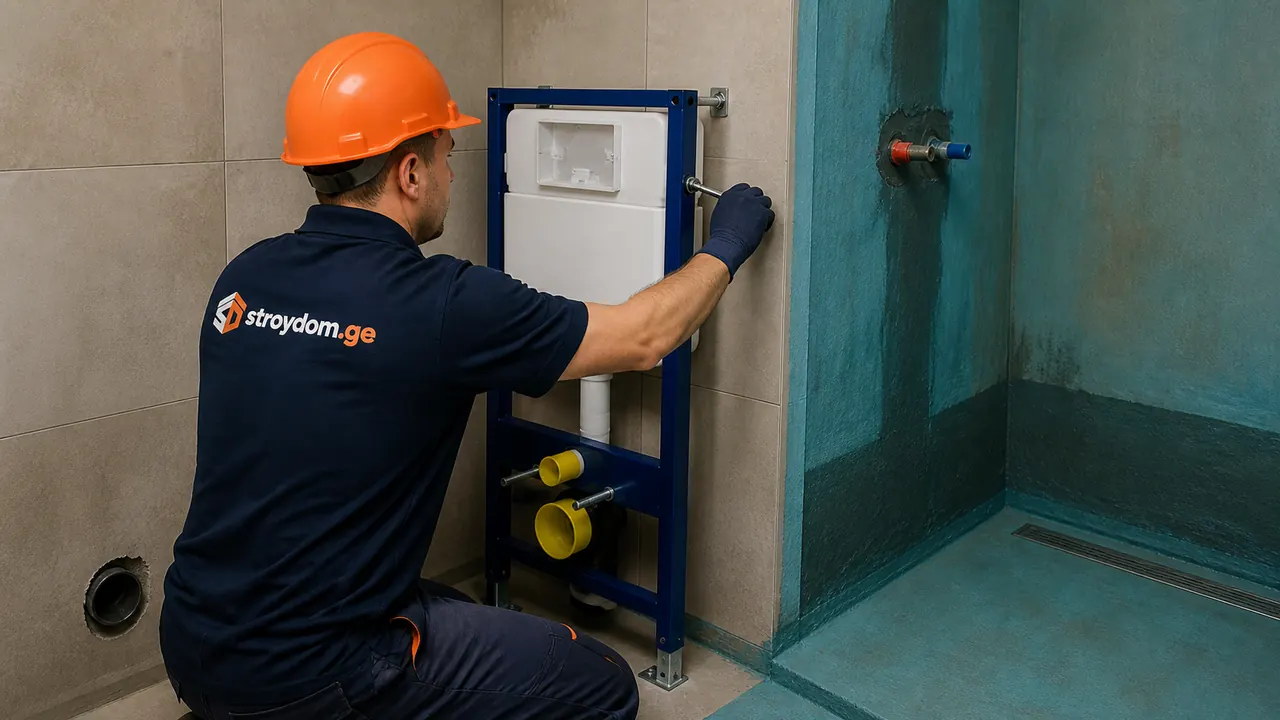
Turnkey bathroom
A turnkey bathroom from stroydom.ge is delivered in apartments and houses in Tbilisi as part of a complete renovation. The full scope for a 4–6 m² bathroom costs 5500–11000 GEL excluding materials and sanitaryware. By stage: strip-out 45–80 GEL/m², water pipework 28–42 GEL per linear metre, drainage 22–55 GEL/m, electrics 55–85 GEL per point. Waterproofing is 18–28 GEL/m², screed with falls 28–42 GEL/m², tiling 35–65 GEL/m². A concealed frame with WC costs 250–450 GEL and a shower system 200–380 GEL. The estimate is fixed in GEL.
We renovate bathrooms and WCs end to end in apartments and houses in Tbilisi: strip-out, relocating and running water and drainage, waterproofing wet areas, screed with falls, tiling and porcelain, plus installation of sanitaryware, furniture and ventilation.
Only as part of comprehensive projects
We deliver this line of work inside a comprehensive project — building a turnkey house or fitting out a property in full. We do not take it as a standalone order: a single warranty is only possible when one contractor answers for the whole chain of work.
About the work
How does stroydom.ge deliver turnkey bathroom?
The whole bathroom: from strip-out to installed sanitaryware.
What is included in turnkey bathroom?
Strip-out
Removing old tiling, sanitaryware and screed with waste taken away.
Services
Manifold or tee water distribution, drainage laid to falls, access points.
Waterproofing
Applied system to floor and walls with tapes at corners and collars on pipes.
Tiling
Set out to an agreed layout, cuts kept out of sight, even joints, shower upstand.
Sanitaryware and furniture
Frames, taps, shower systems, vanity units, mirrors, towel rail.
What is turnkey bathroom and why is it needed?
A bathroom carries more services per square metre than any other room: pressurised water, gravity drainage, ventilation, electrics in a wet zone and tiling over all of it. Correcting any mistake means stripping the finishes completely, so the order of works and the hidden layers matter more here than the choice of tile.
What stages does turnkey bathroom consist of?
Each stage runs only after the previous one is accepted — so hidden works are never "closed" before inspection, and a mistake never has to be hunted for through screed and plaster.
- 1
Survey and layout
Sanitaryware positions, feasibility of moves, tile setting-out.
- 2
Strip-out
Finishes and old sanitaryware removed, waste taken away, substrate assessed.
- 3
Services
Water distribution, drainage to falls, wet-zone electrics, ventilation.
- 4
Pressure test
Water pipework tested before chases are closed.
- 5
Waterproofing
Two coats to floor and walls with tapes and collars, flood-tested for 24 hours.
- 6
Screed and levelling
Falls to the gully in the shower, walls levelled for tiling.
- 7
Tiling
Laid to the agreed setting-out, even joints, access panels formed.
- 8
Final fix
Sanitaryware, furniture, mirrors, lighting, towel rail, clean-up.
How does stroydom.ge control quality on site?
How we work on site — materials, equipment, tolerances, documentation and acceptance of hidden works.
Flood test before tiling
Finished waterproofing is flooded for a day: leaks are found now, not after tiling.
Setting-out on paper
The tile layout is agreed before ordering: it determines both quantity and where cuts fall.
Access panels
Access to stacks, filters and concealed frames is planned in advance.
Pressure-tested pipework
Pipes are tested before plastering, not after the finishes go on.
Photo record
Services and waterproofing are photographed before they are covered, so the owner keeps the layout.
What should be accounted for in Tbilisi and Georgia?
What we account for here: seismic intensity 8 (MSK-64), hot summers and damp winters, steep terrain, older stock with timber floors and worn city networks.
Hard water in Tbilisi
Limescale damages taps and heaters: we allow space for a filter on the incoming main.
Old stacks
In Soviet-era buildings worn cast iron is replaced during the renovation, because afterwards there is no access.
Weak extract
Shared shafts often do not pull. We check the draught before starting and fit an inline fan if needed.
Small bathrooms
Every centimetre counts: ducts and frames are measured on site, not taken from a catalogue.
Neighbours below
Wet-area work is done with waterproofing and a flood test, which protects against both claims and rework.
How much does it cost and how long does it take?
Indicative price ranges in lari (₾) for standard conditions. The final estimate is fixed after measurements and specification approval.
| Item | What is included and the price |
|---|---|
| Guide prices (Tbilisi, before survey) | The figures below are a working guide for budgeting. The firm estimate follows a site visit and survey: scope, access and substrate condition all move the price. |
| Turnkey bathroom | Full scope for 4–6 m²: 5500–11000 GEL excluding materials and sanitaryware. |
| By stage | Strip-out: 45–80 GEL/m²; water pipework: 28–42 GEL per linear metre; drainage: 22–55 GEL/m; electrics: 55–85 GEL per point. |
| Waterproofing and screed | Two-coat applied system: 18–28 GEL/m²; screed with falls: 28–42 GEL/m². |
| Tiling | Walls and floor: 35–65 GEL/m² depending on format; epoxy grout: a further 8–14 GEL per metre of joint. |
| Final fix | Concealed frame with WC: 250–450 GEL; shower system: 200–380 GEL; vanity unit: 150–300 GEL. |
| How we price | By stage: strip-out, services, waterproofing, screed, tiling and final fix as separate lines. |
| What drives the price | Room size and shape, extent of relocations, tile format (large formats are harder), sanitaryware grade. |
| Calculator reference | The site estimator prices apartment renovation from 520 GEL/m²; a bathroom sits above the average rate because of the density of services. |
| Materials | Priced separately from labour: you see what you pay for and can choose tiles and sanitaryware yourself. |
| Terms | Fixed estimate in GEL, staged payments, warranty in the contract. |
Updated:
Ready to estimate?
Leave a request — engineer site visit, measurement and a preliminary estimate for "turnkey bathroom" are free.

Planning to build a house?
Start with a free consultation about your plot, floor area and budget. If you are still looking for land, tell us about a plot you are considering.
We will call within an hour, 24/7. You do not need drawings for the first conversation.
By submitting the form you agree to personal data processing. Privacy Policy
Frequently asked questions — Turnkey bathroom
How long does a bathroom take?
A standard 4–6 m² bathroom takes about 3–5 weeks. The wet trades set the pace: screed gains strength, waterproofing cures, tile adhesive and grout need time. Those stages cannot be rushed, and everything else sits on them. Real delays usually come from materials rather than labour: tiles and sanitaryware must be chosen and delivered before work starts.
Is waterproofing needed if the floor below is also mine?
Yes. Waterproofing protects your own structure, not just the neighbours: a soaked screed and slab lose strength, and mould develops under the tiles, showing up as smell and dark grout. It is a hidden layer costing a few percent of the bathroom budget, and its absence is only found by taking up the whole floor.
Wall-hung frame or floor-standing WC?
A concealed frame frees the floor, simplifies cleaning and hides the pipework, but needs space in the wall or a 15–20 cm duct and proper fixing to solid structure. Floor-standing is cheaper and easier to service. In small Tbilisi bathrooms where every centimetre counts, the choice follows the actual layout rather than fashion.
Can the shower or WC be moved?
The shower and basin move easily because water is under pressure. The WC is limited by drainage, which runs by gravity and needs roughly a 2 cm fall per metre. Moving it one or two metres is usually solved by raising the floor or building a duct; further than that needs a macerator pump, which is less reliable. Feasibility is checked on the survey, before the estimate.
What about old soil stacks?
In older Tbilisi buildings cast iron stacks are often worn out, and replacing them during the renovation is the sensible moment, since afterwards you can only reach them by opening new finishes. Replacement is agreed with the neighbours above and below since it affects a shared section. We always allow an access panel to the stack.
How do you avoid damp and smells?
Three conditions: a working extract (we check the draught before starting), make-up air through a gap under the door or a transfer grille, and a towel rail. A sealed door with no make-up air turns the extract into decoration. If the shared shaft does not pull, we fit an inline fan with a non-return valve.