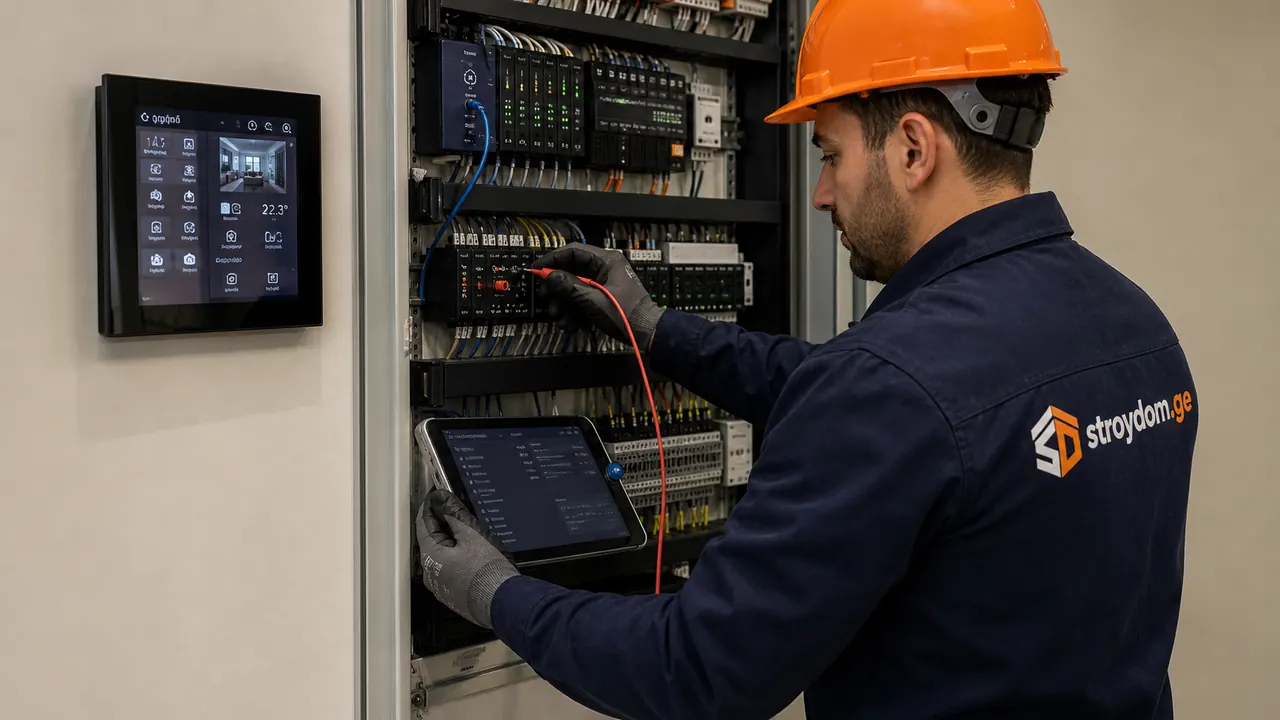
Smart home and low-voltage
Smart home and low-voltage work from stroydom.ge is installed in Tbilisi as a standalone order or as part of a house project, where it is priced with the electrics so chasing happens once. Cable in conduit to a point costs 45–75 GEL per point. A low-voltage panel with switch, controller and power supply is 1200–3500 GEL. A camera installed and set up is 220–450 GEL, a recorder with storage from 700 GEL. A basic scene package is 3500–9000 GEL for an apartment and from 12000 GEL for a house. Leak protection costs 600–1400 GEL installed.
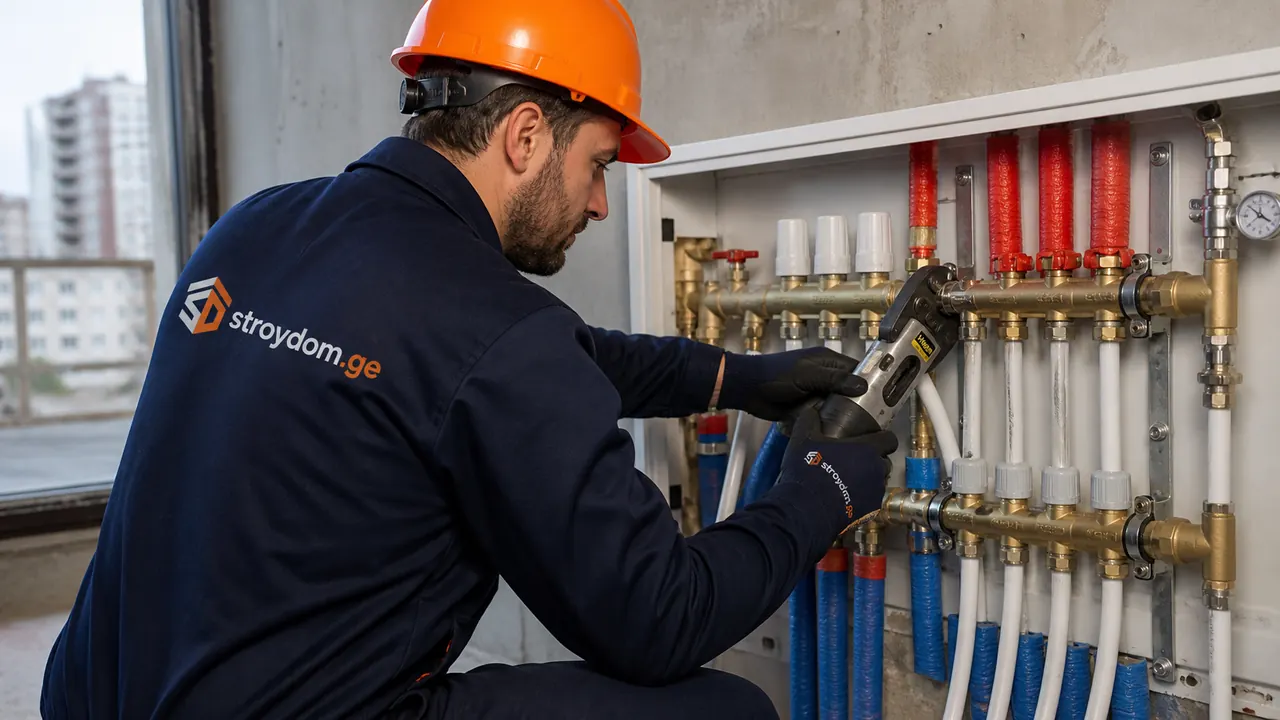
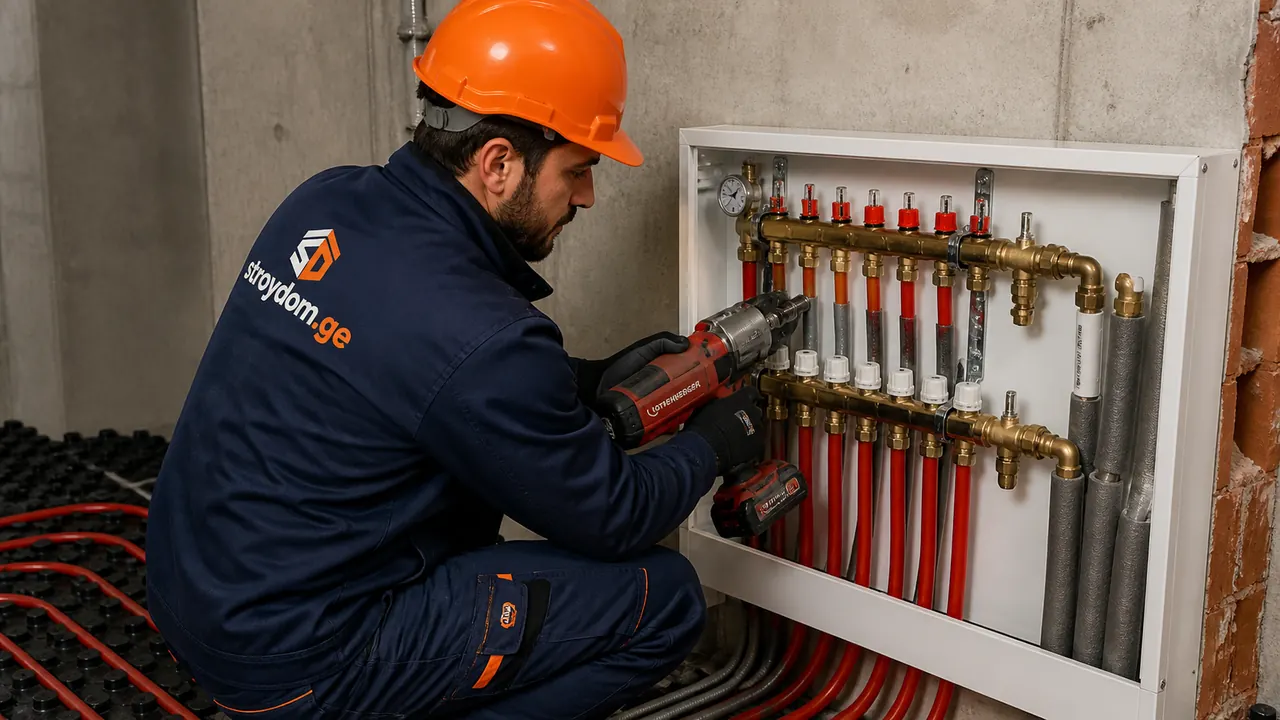
We design and install smart home and low-voltage systems in Tbilisi houses and apartments, as a standalone order or as part of a house project: lighting, climate and blind control, CCTV, intercom and access control, structured cabling and Wi-Fi with no dead zones, leak, smoke and intrusion detection.
Available as a separate order from 1,000 GEL
We take this work as a standalone order from 1,000 GEL, or as part of a turnkey house project. Inside a house project one contractor answers for the whole chain of work: one estimate and one warranty.
About the work
How does stroydom.ge deliver smart home and low-voltage?
Home automation and low-voltage networks, from Wi-Fi to scenes.
What is included in smart home and low-voltage?
Low-voltage design
Routes, outlets and panel layout drawn before chasing and first fix.
Network and Wi-Fi
Twisted pair to every point, switch, access points with seamless roaming.
Automation
Lighting, climate, blind and irrigation scenes, panels and mobile control.
Security
Recording cameras, intercom, electric locks, leak, smoke and motion sensors.
Commissioning
Scene setup, every line tested, handover training for the owner.
What is smart home and low-voltage and why is it needed?
A smart home is useful not for "control from your phone" but for removing everyday risks and chores: water shut off before a flood, climate on a schedule, lighting and gate on one scene. All of it rests on low-voltage infrastructure that can only be installed during first fix; afterwards only compromises remain. So we design low-voltage alongside the electrics, before chasing.
What stages does smart home and low-voltage consist of?
Each stage runs only after the previous one is accepted — so hidden works are never "closed" before inspection, and a mistake never has to be hunted for through screed and plaster.
- 1
Scenes and requirements
What should run automatically, where panels and switches go.
- 2
Design
Routes, outlets, panel and equipment layout; power and low-voltage separated.
- 3
Containment
Conduit and cable before first fix, with spare length in the panel and at outlets.
- 4
Low-voltage panel
Switch, controller, power supply, ventilation and space for expansion.
- 5
Network and Wi-Fi
Twisted pair to access points, seamless roaming configured across the house.
- 6
Equipment
Cameras, intercom, sensors, actuators, switches and panels.
- 7
Scene configuration
Logic for lighting, climate, blinds, responses to leaks and motion.
- 8
Handover
Every line tested, network documentation, training and credentials handed over.
How does stroydom.ge control quality on site?
How we work on site — materials, equipment, tolerances, documentation and acceptance of hidden works.
Documentation handed over
The owner receives the network schematic, addresses and credentials. The system is not tied to one contractor.
Local logic
The main scenes run inside the house and do not depend on cloud or internet.
Separated routes
Low-voltage runs apart from power cabling: otherwise interference and an unstable network.
Room to grow
Spare conduit capacity and panel space: adding devices does not mean opening walls.
Passwords changed
Factory passwords on cameras and routers are changed at handover, otherwise the CCTV is exposed.
What should be accounted for in Tbilisi and Georgia?
What we account for here: seismic intensity 8 (MSK-64), hot summers and damp winters, steep terrain, older stock with timber floors and worn city networks.
Power cuts
Controller, router and cameras go on a UPS: without power a smart home controls nothing.
Thick walls
In pumice-block and concrete houses Wi-Fi does not pass between floors, so access points go on cable, not repeaters.
Heat
A populated low-voltage panel runs warm: ventilation and spare space matter, especially in summer.
External cameras
Moisture and temperature swings: sealed glands, hoods, heated housings for mountain locations.
Compatibility
We select equipment with open protocols so you are not locked into a single brand.
How much does it cost and how long does it take?
Indicative price ranges in lari (₾) for standard conditions. The final estimate is fixed after measurements and specification approval.
| Item | What is included and the price |
|---|---|
| Guide prices (Tbilisi, before survey) | The figures below are a working guide for budgeting. The firm estimate follows a site visit and survey: scope, access and substrate condition all move the price. |
| Low-voltage containment | Cable in conduit to a point: 45–75 GEL per point, in line with power circuits. |
| Low-voltage panel | Built with switch, controller and power supply: 1200–3500 GEL depending on the number of lines. |
| CCTV | Camera with installation and setup: 220–450 GEL; recorder with storage: from 700 GEL. |
| Automation | Basic scene package for an apartment: 3500–9000 GEL; for a house, from 12000 GEL with climate and blinds. |
| Leak protection | Kit with motorised valve and sensors: 600–1400 GEL installed. |
| How we price | By points and lines: containment, panel, equipment and configuration as separate items. |
| What drives the price | Number of controlled lines and points, equipment class, whether CCTV and climate are included, house area. |
| Minimum provision | On a tight budget we install routes and the panel at first fix, with equipment added later. |
| Within a renovation | Low-voltage belongs to the services stage and is priced with the electrics so chasing happens once. |
| Terms | Fixed estimate in GEL, staged payments, installation warranty in the contract. |
Updated:
Ready to estimate?
Leave a request — engineer site visit, measurement and a preliminary estimate for "smart home and low-voltage" are free.

Planning to build a house?
Start with a free consultation about your plot, floor area and budget. If you are still looking for land, tell us about a plot you are considering.
We will call within an hour, 24/7. You do not need drawings for the first conversation.
By submitting the form you agree to personal data processing. Privacy Policy
Frequently asked questions — Smart home and low-voltage
Wired or wireless smart home?
Wireless systems install into a finished flat without chasing and make sense when the renovation is already done. A wired system is more reliable: it does not depend on radio interference or battery life, and switches keep working through any failure. During a renovation it is worth pulling cable even for automation you may add later: cable in the wall costs very little, and it cannot be added afterwards.
What should be installed if a smart home is not planned yet?
A minimum: twisted pair to every TV position and Wi-Fi point, cable to the gate and intercom, routes to perimeter cameras, and a low-voltage panel with space and power for equipment. That is a few hundred GEL at first fix and complete freedom to add later. Without it, any automation falls back on radio devices and surface boxes.
Will the house work without internet?
Designed properly, yes. Local scenes (lighting, climate, blinds, leak alarms) run on a controller inside the house, and internet is only needed for remote access and notifications. If a system depends entirely on the manufacturer cloud, an internet outage turns a smart home into an unmanageable one. That is our criterion when selecting equipment.
How many cameras does a house need?
It is counted by zones, not by number: the gate approach, the entrance, building corners on the perimeter, yard and parking, plant room. For a typical house that is 4–8 cameras. Placement and lighting matter more than count: one camera with a good angle and illumination beats four looking at bright sky and a dark yard.
Why fit leak sensors when there is insurance?
A sensor with a motorised valve on the incoming main shuts water off in seconds, while insurance pays weeks later and does not return the time lost to repairs and drying out. A kit for kitchen and bathrooms costs a few hundred GEL and pays for itself with the first incident, especially in a flat, where a leak also means repairs for the neighbour below.
When should low-voltage design start?
Together with the electrical design, before any chasing. Low-voltage routes run separately from power to avoid interference, and their paths affect where the panel and furniture go. A design done after first fix always means either surface trunking or opening the walls again.