Septic tank and off-grid sewage
Off-grid sewage in Tbilisi and the suburbs is installed turnkey by stroydom.ge: a 3–5 m³ holding tank costs 2,200–4,000 ₾ connected, a multi-chamber septic with filtration field 3,500–6,500 ₾, a deep bio-treatment plant for 4–8 users 5,500–11,000 ₾ commissioned. Interior drainage costs 35–60 ₾ per linear metre. Service: a pump-out 80–150 ₾ per visit, plant servicing 200–400 ₾ per year. The estimate follows a site visit. The system comes within a full build project.
We design and install off-grid sewage for houses without a central sewer connection: from a simple holding-tank septic to a deep biological treatment plant. The system type is chosen from site geology (the soil must accept treated effluent), the number of permanent residents, and discharge requirements: a slope, a well, or a nearby water body each change the answer from a flat plot.
Available as a separate order from 1,000 GEL
We take this work as a standalone order from 1,000 GEL, or as part of a turnkey house project. Inside a house project one contractor answers for the whole chain of work: one estimate and one warranty.
About the work
How does stroydom.ge deliver septic tank and off-grid sewage?
Off-grid sewage for plots without a central line. The septic type is chosen by the soil and household size, not by catalogue price.
What is included in septic tank and off-grid sewage?
Holding tank septic
A sealed tank with no discharge into the soil, for sites with a high water table or near a well. It needs regular pump-out.
Septic with filtration field
A multi-chamber septic with final treatment through a subsurface filtration field or seepage pit, for permeable soil and enough plot area.
Deep bio-treatment plant
An aerobic plant with forced aeration, treating 95–98% of the effluent, so discharge onto terrain or into a drainage ditch is allowed.
Interior drainage
Piping from bathrooms and the kitchen to the septic with correct fall, stack venting and inspection points.
Service
Scheduled sludge pump-out, filter and compressor replacement on treatment plants, diagnostics for flooding or blockages.
What is septic tank and off-grid sewage and why is it needed?
Off-grid sewage is needed on most suburban Tbilisi plots and nearly all rural ones, because the central network doesn't reach there. Unlike water supply, where a mistake means inconvenience, a mistake in sewage means contaminating your own plot and the neighbours'. A septic runs at the edge of its capacity from day one and is sized for steady, not peak, load.
Choosing the right system starts with three questions (what soil, what water table, and is there a well or water body nearby), not with an equipment catalogue.
What stages does septic tank and off-grid sewage consist of?
Each stage runs only after the previous one is accepted — so hidden works are never "closed" before inspection, and a mistake never has to be hunted for through screed and plaster.
- 1
Site survey
Soil type, water table, distance to any well, water body and neighbouring boundaries, terrain.
- 2
Load calculation and type selection
Effluent volume from permanent occupancy and choice of system: holding tank, filtration field or bio-treatment plant.
- 3
Earthworks
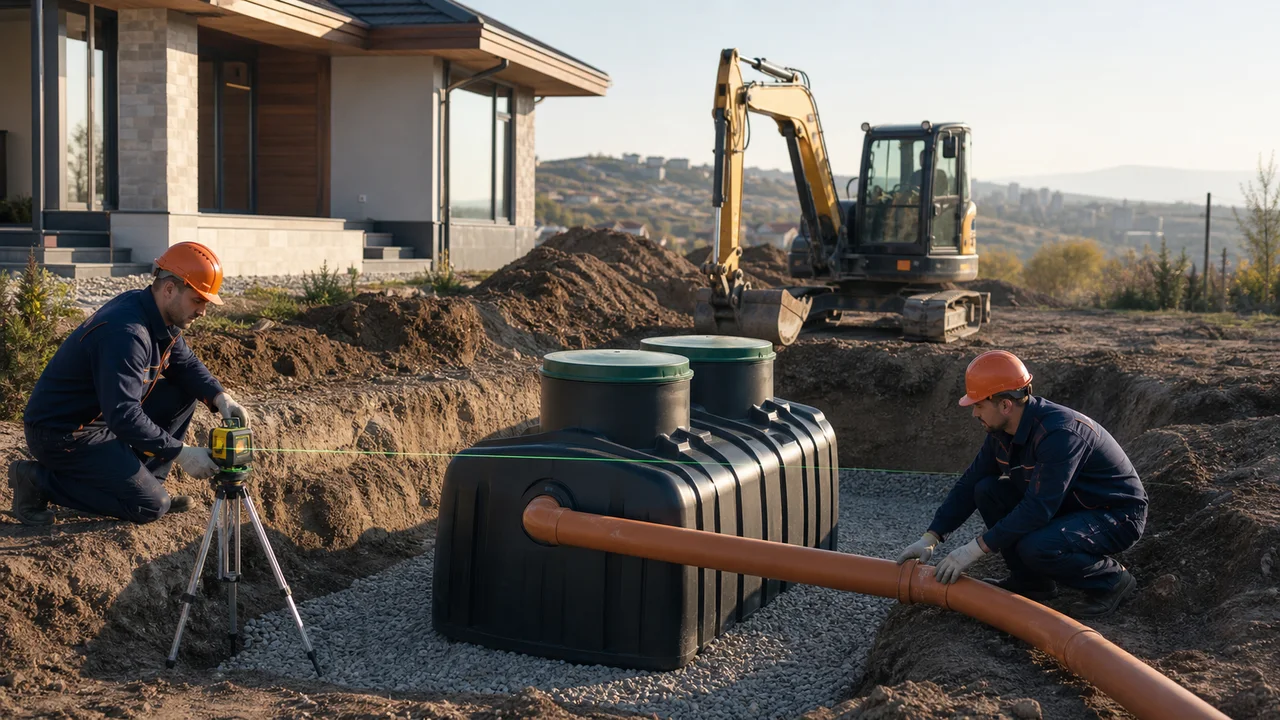
Excavation for the tank or plant, a trench from the house with a 2 cm-per-metre fall, and an area for the filtration field where that option applies.
- 4
Tank installation
Setting the septic or plant on a concrete base with anchoring, because at a high water table an empty tank can float without ballast.
- 5
Connection and venting
Connecting the pipe from the house, fitting a vent stack and inspection points for clearing blockages.
- 6
Filtration field or discharge
Laying drainage pipes in gravel for a filtration field, or a discharge line for treated water to a ditch or terrain for a plant.
- 7
Backfill and start-up
Layered backfill without damaging the tank, commissioning the plant where fitted, maintenance briefing.
How does stroydom.ge control quality on site?
How we work on site — materials, equipment, tolerances, documentation and acceptance of hidden works.
Fall on the house pipe
The gravity pipe holds a 2 cm-per-metre fall along its whole length: too much or too little fall causes blockages either way.
Tank ballasting
At a high water table a plastic septic is anchored to a concrete slab, otherwise an empty tank floats during a flood or after a pump-out.
Sanitary setbacks
Distances to a well, water body and property lines are checked before earthworks, not after installation, because relocating a finished system costs far more than planning ahead.
Service access
The septic or plant access hatch stays at grade or with a short riser. Buried under paving or lawn, it becomes unfindable later.
Where the treated water goes
The outlet is designed from the soil: a soakaway in sand, a dispersal field in loam, a holding tank with tankering on clay and high groundwater. An error here waterlogs the plot, not the septic tank.
Venting and smell
The soil vent pipe is taken above roof level and treatment plants get their own extract. Without venting the smell comes indoors through the traps, and no chemical fixes that.
What should be accounted for in Tbilisi and Georgia?
What we account for here: seismic intensity 8 (MSK-64), hot summers and damp winters, steep terrain, older stock with timber floors and worn city networks.
A well nearby
On small suburban plots a drinking-water well and the required sanitary setback often physically leave no room for a filtration field, so we solve it with a deep treatment plant or a holding tank.
Tbilisi's clay soils
A large part of the suburbs sits on clay and loam with low permeability. A filtration field won't work there without replacing soil to a significant depth, so we more often fit a bio-treatment plant.
High water table in low ground
On low-lying plots and near riverbeds, water rises seasonally close to the surface, so we design the septic and plant for buoyancy and for sealing against groundwater pressure.
Storms and flash floods
After heavy rain the water table can spike briefly higher than the seasonal norm. The filtration field and discharge line are placed so floodwater doesn't back up into the chambers.
A sloped plot
Gravity flow from the house to the septic on a slope sometimes needs a lift pump if the natural fall runs the wrong way. We route the line to the actual terrain, not a straight line on the plan.
Seasonal use
For a guest house or weekend property with occasional occupancy, a holding tank with pump-outs can be cheaper over several years than a treatment plant, because the pump-out premium at low load is less than year-round plant servicing.
How much does it cost and how long does it take?
Indicative price ranges in lari (₾) for standard conditions. The final estimate is fixed after measurements and specification approval.
| Item | What is included and the price |
|---|---|
| Ballpark (Tbilisi, before survey) | Prices below are for budgeting. The exact estimate follows a site visit: soil type, water table, distance from the house and equipment access change the cost. |
| Holding tank septic | A 3–5 m³ tank installed and connected: 2,200–4,000 ₾, not including regular pump-outs. |
| Septic with filtration field | A multi-chamber septic with a filtration field, turnkey: 3,500–6,500 ₾ depending on volume and field area. |
| Deep bio-treatment plant | A plant for 4–8 users, installed and commissioned: 5,500–11,000 ₾. |
| Interior drainage | 35–60 ₾ per linear metre of pipe from fixtures to the outlet, installed. |
| Service | Holding tank pump-out: 80–150 ₾ per visit; bio-treatment plant service: 200–400 ₾ per year. |
Updated:
Ready to estimate?
Leave a request — engineer site visit, measurement and a preliminary estimate for "septic tank and off-grid sewage" are free.

Planning to build a house?
Start with a free consultation about your plot, floor area and budget. If you are still looking for land, tell us about a plot you are considering.
We will call within an hour, 24/7. You do not need drawings for the first conversation.
By submitting the form you agree to personal data processing. Privacy Policy
Frequently asked questions — Septic tank and off-grid sewage
Which septic fits my specific plot?
The answer comes from how well the soil accepts treated water and the water table level, not the budget. On sandy or loamy soil with a water table below about 1 m under the filtration field, a septic with a filtration field is the cheapest to run. On clay, loam or a high water table, the ground won't absorb the effluent, and only a deep bio-treatment plant or a holding tank will do. Next to a drinking-water well or a body of water, a filtration field is off the table entirely because the required sanitary setback doesn't allow it. That leaves a plant treated to discharge standards, or a holding tank with pump-out.
What is the difference between a septic with a filtration field and a deep treatment plant?
A septic with a filtration field settles solids and breaks them down anaerobically, with final treatment happening in the soil. It is cheap to run but needs area for the field (typically 20–40 m²) and suitable ground. A deep bio-treatment plant forces air through the effluent and treats it to 95–98% without relying on soil at all. It works on any plot regardless of geology, and the water can go into a ditch or onto terrain, but the plant draws electricity and needs servicing once or twice a year.
How often does a septic need pumping out?
Depends on the type and load. An untreated holding tank is pumped as it fills: for a family of four that's roughly every 3–6 weeks, which makes it expensive to run full-time and more sensible for a weekend house or occasional use. A septic with a filtration field needs the first chamber's sludge pumped every 1–2 years. A deep treatment plant, running normally, removes excess sludge itself; manual pump-out is only needed once every year or two as maintenance.
Can a septic go on a sloped plot?
Yes, with adjustments. The septic sits below the house's drain outlet so waste flows by gravity, which on a slope can mean a deeper excavation and a retaining wall beside it if the ground is unstable. A filtration field on a slope can't sit above a water source or below the house in the stormwater path, otherwise runoff floods the chambers. On difficult terrain we more often fit a deep treatment plant with forced discharge onto terrain, since it depends less on the plot's slope.
How far does a septic need to be from the house, a well and the property line?
As a rough guide: at least 5 m from the house, 25–50 m from a drinking-water well depending on soil and system type, 2–3 m from a neighbouring boundary, and 10–30 m from a body of water. The exact figures depend on the septic type and local code. The well is usually the tightest constraint: on a small plot it often physically leaves no room for a filtration field, pushing the choice toward a treatment plant or a holding tank instead.
What happens if I pick the cheapest option regardless of soil?
A holding tank on a plot with enough room for a filtration field overpays on pump-outs for years. And a filtration field on clay or a high water table simply won't work: the effluent has nowhere to go, the chambers overflow, and water surfaces on the lawn the first rainy season, with the rebuild costing more than getting it right the first time. The system type is a decision to make from the geology, not from the lowest price in a listing.