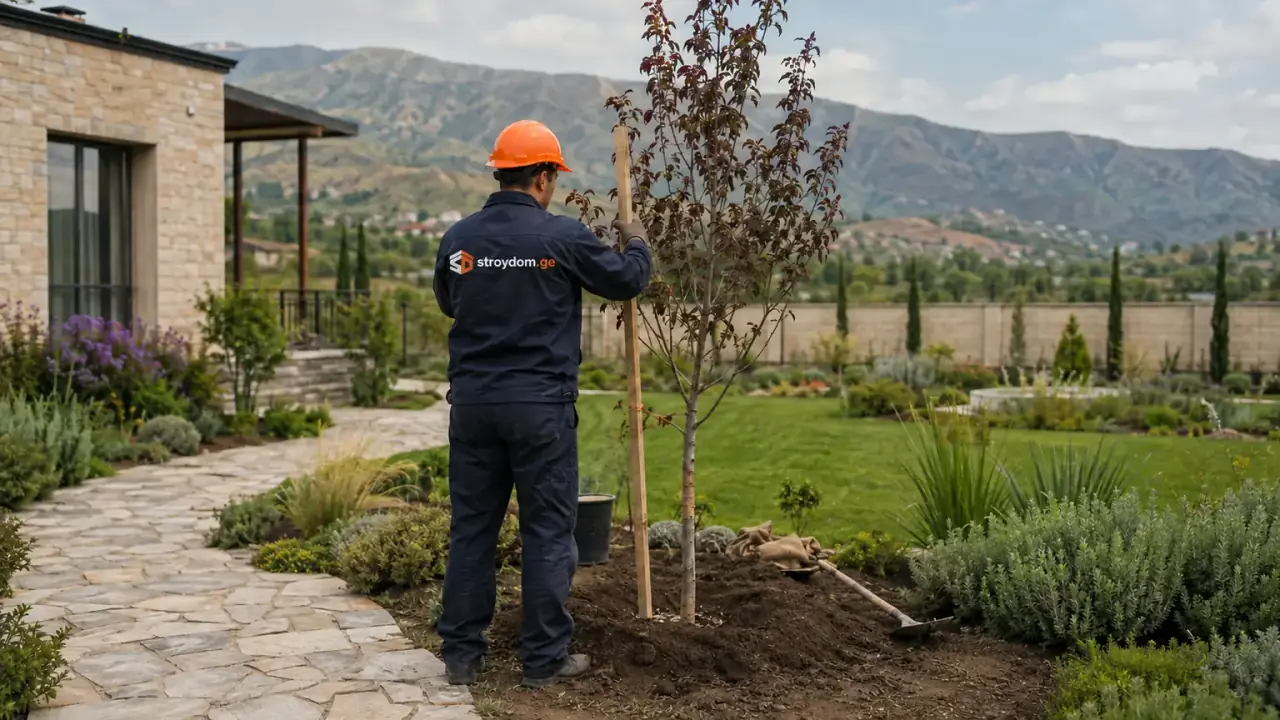
Landscape design
Landscaping in Tbilisi and the suburbs is priced by line at stroydom.ge: the planting plan costs 15–30 ₾/m², credited against the build-out on a turnkey order. Turf costs 25–40 ₾/m², seeded lawn 12–20 ₾/m², a sapling 80–350 ₾, a hedge 45–90 ₾ per linear metre, a fruit tree 90–180 ₾, a garden light 60–120 ₾ per point. Design starts from 100 m² of planted area.
We design and build out landscaping for a plot in Tbilisi and the suburbs: a zoning and planting plan fitted to the specific site's terrain and slope, lawn installation, trees and shrubs chosen for the local climate and soil, ornamental and fruit planting, an irrigation system and landscape lighting. We take it as a standalone order or as part of a house project, where the garden layout is planned at the landscaping stage.
Available as a separate order from 1,000 GEL
We take this work as a standalone order from 1,000 GEL, or as part of a turnkey house project. Inside a house project one contractor answers for the whole chain of work: one estimate and one warranty.
About the work
How does stroydom.ge deliver landscape design?
Planting and garden layout: the part that comes after the hardscape (retaining walls, paving, fences) but shapes what the plot feels like to live with.
What is included in landscape design?
Planting plan
Zoning the plot, choosing plants for light exposure, soil and slope, a planting plan accounting for each tree's mature size.
Lawn
Roll-on or seeded lawn with prepared base, drainage and an irrigation system matched to the grass variety.
Trees and shrubs
Planting ornamental and shade trees, hedges and shrubs, chosen for local climate and suburban frost tolerance.
Orchard
Layout and planting of fruit trees and grapevines, accounting for light exposure, spacing and crop compatibility.
Lighting and features
Landscape lighting for paths and planting, integration with irrigation, pads for garden furniture and gazebos.
What is landscape design and why is it needed?
Landscape design is the one part of a finished plot that keeps growing and changing rather than staying fixed like a built wall or laid paving. A mistake here doesn't break a structure, but it shows up slower and costs more than it looks like at the start: a poorly chosen tree by the foundation needs felling a decade later and damages the apron slab in the process; a lawn without drainage turns into a bog after the first heavy rain; ornamentals unsuited to the climate freeze and need replanting every spring. We design the garden as a system for years ahead rather than as a one-off planting from a catalogue, accounting for mature plant size, the seasonality of Tbilisi's climate, and its links to the plot's engineering (irrigation, drainage, lighting).
What stages does landscape design consist of?
Each stage runs only after the previous one is accepted — so hidden works are never "closed" before inspection, and a mistake never has to be hunted for through screed and plaster.
- 1
Site survey
Light exposure by zone, soil type and acidity, slope, existing trees and underground utilities.
- 2
Zoning plan
Lounging areas, lawn, planting beds and orchard, laid out for terrain and shade from the house and neighbouring buildings.
- 3
Soil preparation
Surface grading, soil improvement, drainage on low and waterlogged spots.
- 4
Irrigation system
Line runs laid under the future lawn and planting, before turf and plants go in.
- 5
Lawn
Roll-on turf or seeding, chosen by timeline and budget, with final base preparation.
- 6
Planting
Trees, shrubs, fruit and ornamental plants per the plan, timed to the correct planting season.
- 7
Lighting and handover
Landscape fixtures, final trimming and cleanup, handover of the planting plan and care schedule.
How does stroydom.ge control quality on site?
How we work on site — materials, equipment, tolerances, documentation and acceptance of hidden works.
Planting season
Trees and shrubs go in at the right time of year (spring or autumn), not whenever it's convenient: summer heat transplanting sharply cuts survival rates.
Irrigation under the planting
Lines are laid in advance, each zone calibrated to the water needs of its specific plants rather than one uniform schedule across the plot.
Drainage on low spots
Waterlogged areas are drained before the lawn goes in. Otherwise roots rot and the grass fails in patches.
Distance from structures
Large trees are planted set back from the foundation, paths and retaining walls by the plant's actual mature size.
What should be accounted for in Tbilisi and Georgia?
What we account for here: seismic intensity 8 (MSK-64), hot summers and damp winters, steep terrain, older stock with timber floors and worn city networks.
Tbilisi's hot, dry summer
A lawn and young planting without irrigation burn out in a couple of weeks of summer heat, so an irrigation system is a survival condition for greenery in the first year rather than an option.
Elevation change in the suburbs
Kojori and Tskneti run colder than lowland Tbilisi, so plants suited to the city may not survive winter at altitude; we choose the plant list for the plot's actual elevation.
Clay and rocky soils
Roots suffocate in dense clay without drainage; on rocky ground we dig planting holes larger than standard with soil replacement, otherwise the sapling doesn't take.
Roots near the foundation and retaining walls
Large trees closer than 5 m to the house eventually deform the apron slab and drainage behind a retaining wall, so we set the distance at the design stage rather than moving a mature tree after a complaint.
Coordinating with construction
On a plot where building is still underway, equipment and material storage kill a lawn and young planting, so we schedule landscaping as the last stage, after the dirty work is done.
Care after handover
In the first year after planting, plants need regular watering and feeding until the root system develops, so we hand the client a care schedule rather than leaving the garden as-is.
How much does it cost and how long does it take?
Indicative price ranges in lari (₾) for standard conditions. The final estimate is fixed after measurements and specification approval.
| Item | What is included and the price |
|---|---|
| Ballpark (Tbilisi, before survey) | Prices below are for budgeting. The exact estimate follows a site visit: area, terrain and soil condition change the scope. |
| Planting plan | A design with a planting plan and zoning: 15–30 ₾/m² of plot, credited against the build-out cost on a turnkey order. |
| Lawn | Roll-on turf, turnkey: 25–40 ₾/m²; seeded with base prep: 12–20 ₾/m². |
| Trees and shrubs | A sapling installed: 80–350 ₾ depending on species and age; a hedge: 45–90 ₾ per linear metre. |
| Orchard | A fruit tree planted with hole and feeding: 90–180 ₾ each. |
| Garden lighting | Landscape fixtures with cable run: 60–120 ₾ per point. |
| Minimum scope | We design from 100 m² of planted area; on smaller plots the design is a fixed price, not tied to m². |
Updated:
Ready to estimate?
Leave a request — engineer site visit, measurement and a preliminary estimate for "landscape design" are free.

Planning to build a house?
Start with a free consultation about your plot, floor area and budget. If you are still looking for land, tell us about a plot you are considering.
We will call within an hour, 24/7. You do not need drawings for the first conversation.
By submitting the form you agree to personal data processing. Privacy Policy
Frequently asked questions — Landscape design
How is landscape design different from site landscaping?
Site landscaping (blagoustroystvo) is the engineering layer: retaining walls, paved paths, fencing, water drainage. Landscape design starts where the engineering ends and answers a different question: what grows, where, and how it looks across the seasons. Lawn, trees, shrubs, flower beds and an orchard form a separate layer on top of the hardscape, with its own plan and timing: planting follows the season, not concrete curing schedules.
Should landscape design start before or after the house is built?
The garden zoning plan is sensible to do alongside the house design: large trees, canopy shade, paths and lounging areas all relate to where the house sits on the plot and to underground utility routes. The actual planting, though, comes after construction and dirty earthworks are done, because equipment and material storage on site kill a lawn and young trees faster than they can be regrown.
What plants survive in Tbilisi and the suburbs?
Tbilisi is a hot, dry-summer, cool-and-occasionally-frosty-winter zone, and in the suburbs (Kojori, Tskneti) the elevation change adds its own correction: what grows in the valley can freeze at altitude. Mediterranean and native Caucasian species do well: they tolerate summer drought without constant watering and aren't bothered by winter frost. Imported ornamentals bred for milder climates often need winter cover or die in the first cold season, so we choose the plant list for the plot's actual elevation, not from a nursery catalogue.
Do I need irrigation if I already have a lawn and flower beds?
In a Tbilisi summer a lawn without irrigation burns out within 2–3 weeks of dry weather, and first-year plantings die if watering is missed for a few days in the heat. Hand-watering with a hose only works while the owner is on site every day, which is unrealistic for a rental or seasonal stay. We build the irrigation system into the planting plan from the start rather than retrofitting it into a finished lawn: the lines run under the planned planting, not over it.
Can trees be planted right up against the house and a retaining wall?
Not recommended: a large tree's root system can deform the apron slab, the foundation and the drainage behind a retaining wall within 10–15 years, while a canopy against the facade traps moisture on the wall and encourages mould. The minimum distance depends on species: 5–8 m from the foundation for fast-growing large trees, 1–2 m for shrubs and low forms. We plan planting positions for the plant's mature size, not just where the sapling fits today.