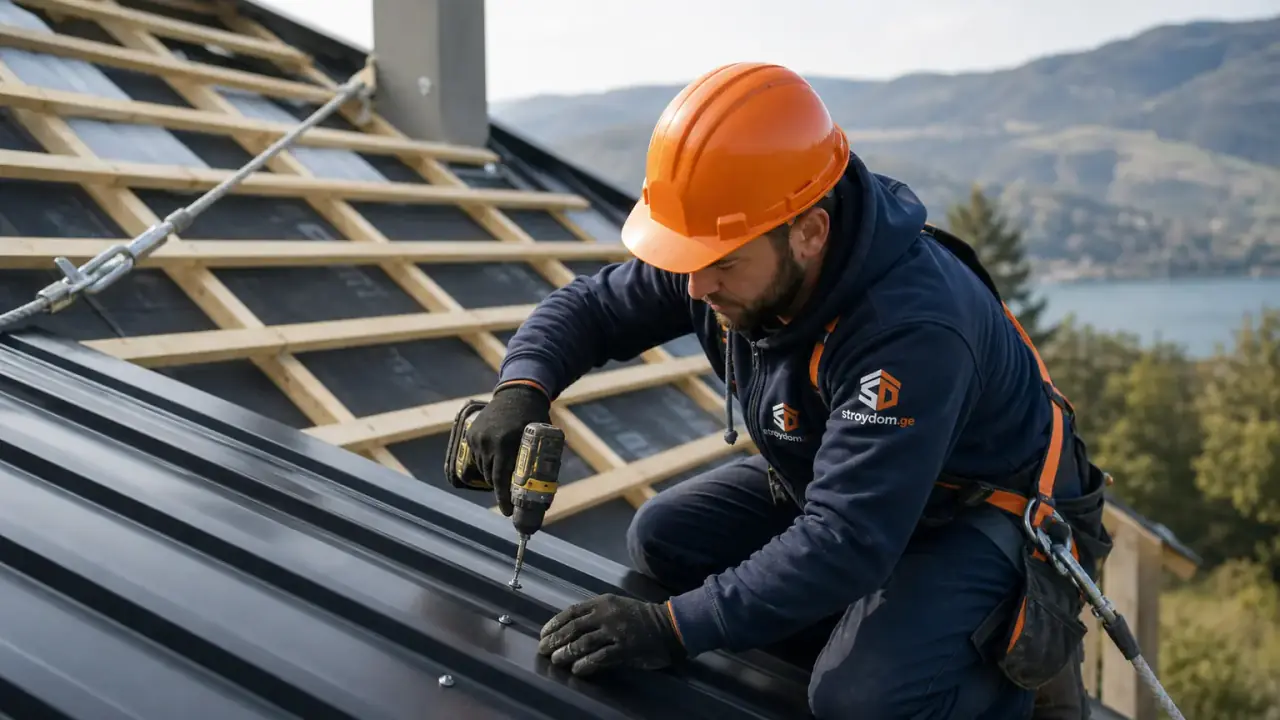
Torch-on roof waterproofing
A flat roof in torch-applied sheet is quoted by stroydom.ge in Tbilisi and across Georgia at a fixed price covering substrate preparation, primer, two layers of sheet, upstand details and outlets, waste removal, a flood test and a concealed-works certificate. Replacing insulation, repairing the deck and forming new outlets or parapets are priced separately. The estimate follows a roof survey. The work comes within a full build project.
We cover flat roofs with torch-applied bitumen-polymer sheet (roofing felt and its modern equivalents) in Tbilisi and across Georgia: garages, outbuildings, extensions, plant roofs and repairs to existing coverings. We form falls to the outlets, lay two layers with staggered laps and treat parapets and upstands as a separate operation, because that is where roofs actually leak. If a single-ply membrane would serve the structure better, we say so and price both.
Available as a separate order from 1,000 GEL
We take this work as a standalone order from 1,000 GEL, or as part of a turnkey house project. Inside a house project one contractor answers for the whole chain of work: one estimate and one warranty.
About the work
How does stroydom.ge deliver torch-on roof waterproofing?
Torch-on bituminous membrane for flat roofs, where it suits the structure and the budget.
What is included in torch-on roof waterproofing?
Forming falls
A 1.5–3% fall to the outlets in screed or tapered insulation. Without it water ponds and finds the weakest lap.
Substrate preparation
Cleaning, crack repair and bitumen priming: torch-on sheet does not bond to a dusty deck.
Two staggered layers
Underlay and cap sheet with offset joints, 80–100 mm laps and controlled torching.
Parapets and upstands
At least 250 mm up the vertical, a fillet in the corner and a mechanical termination bar on top.
Outlets and overflows
Outlets with clamping flanges and emergency overflows through the parapet.
Repairing old roofs
Opening blisters, drying out, local patches or a full overlay on the existing build-up.
What is torch-on roof waterproofing and why is it needed?
A flat roof is the most water-loaded structure on the building: everything that falls on its area arrives there, and the only way out is the outlet. Torch-on waterproofing solves that cheaply and predictably, but only on three conditions: there is a fall, the deck is dry and prepared, and the upstands are built as a proper detail rather than simply turned up the wall. Break any one of them and the roof leaks in its first season, which is why these roofs have a poor reputation.
What stages does torch-on roof waterproofing consist of?
Each stage runs only after the previous one is accepted — so hidden works are never "closed" before inspection, and a mistake never has to be hunted for through screed and plaster.
- 1
Survey
Condition of the deck, whether a fall exists, moisture in the insulation via trial cuts.
- 2
Costing the options
We price torch-on and membrane and show the difference in cost and service life.
- 3
Strip-out or preparation
Removing an unusable build-up, or repairing and drying the existing one.
- 4
Forming falls
Falls to the outlets in screed or tapered insulation.
- 5
Priming
Bitumen primer across the whole area, dust removal, drying.
- 6
Torching on
Two layers with offset joints, controlled heat and lap width.
- 7
Details
Parapets, upstands, outlets, overflows, vent penetrations.
- 8
Handover
Flood test, joint inspection, photo record, concealed-works certificate, warranty.
How does stroydom.ge control quality on site?
How we work on site — materials, equipment, tolerances, documentation and acceptance of hidden works.
The fall is not optional
A roof without a fall will leak whatever the material: standing water finds a lap. We put the falls in the estimate from the start, never as a variation.
Controlled torching
An under-heated lap has not bonded; an over-heated one has burnt. We work to the bitumen bead ahead of the roll, not by eye.
Staggered joints
Cap sheet joints are offset from the underlay by half a roll, otherwise you build a continuous line of weakness.
Height of the upstand
At least 250 mm up the parapet with a fillet in the corner and a termination bar on top. Economising here causes most leaks.
Moisture under the build-up
We open trial cuts first: wet insulation must never be overlaid, the water stays in and lifts the sheet into blisters.
Flood test
The roof is flooded and inspected from below before the site is closed. Leaks get found now, not next spring.
What should be accounted for in Tbilisi and Georgia?
What we account for here: seismic intensity 8 (MSK-64), hot summers and damp winters, steep terrain, older stock with timber floors and worn city networks.
Tbilisi downpours
Summer storms deliver a peak flow in a short time. One outlet on a small roof is not enough: an emergency overflow through the parapet keeps water from going in through the upstand.
Sun and heat
A dark bituminous surface gets very hot in summer. On trafficked and habitable roofs we add a protective layer (mineral finish, gravel or pavers on pedestals), otherwise the sheet ages noticeably faster.
Later additions
Air conditioners, aerials and vent outlets fitted after the roof puncture the covering. We build sealed penetrations in advance and ask to be consulted about new ones.
Old garages
Garages and outbuildings often have neither a fall nor an outlet, so water simply runs off the edge. That gets rebuilt together with the roof, otherwise the new covering repeats the fate of the old.
How much does it cost and how long does it take?
Indicative price ranges in lari (₾) for standard conditions. The final estimate is fixed after measurements and specification approval.
| Item | What is included and the price |
|---|---|
| What the price covers | Substrate preparation, primer, two layers of sheet, upstand details and outlets, waste removal, flood test and concealed-works certificate. |
| What drives it | Roof area and geometry, number of upstands and penetrations, whether the old build-up must be stripped and falls formed, and the grade of sheet. |
| Priced separately | Replacing insulation, repairing the structural deck, forming new outlets and parapets, protective finishes on a trafficked roof. |
| When dearer is cheaper | If the survey shows wet insulation or no fall, the full build-up costs more than patching but ends the annual repair cycle. |
Updated:
Ready to estimate?
Leave a request — engineer site visit, measurement and a preliminary estimate for "torch-on roof waterproofing" are free.

Planning to build a house?
Start with a free consultation about your plot, floor area and budget. If you are still looking for land, tell us about a plot you are considering.
We will call within an hour, 24/7. You do not need drawings for the first conversation.
By submitting the form you agree to personal data processing. Privacy Policy
Frequently asked questions — Torch-on roof waterproofing
Is roofing felt not an obsolete material?
What is obsolete is cardboard-based felt on oxidised bitumen: it lasted 5–7 years and cracked in the cold. Modern torch-on sheets of the same family are built on polyester or glass fleece with modified bitumen (SBS/APP) and last 15–25 years. That is what we use; the old name stuck, the material did not.
Torch-on felt or PVC membrane?
It depends on the roof. Torch-on is cheaper up front, can be patch-repaired and copes well with complicated geometry and many upstands. Membrane costs more but is lighter, faster to lay and lasts longer over large simple areas. On a garage, outbuilding or extension torch-on usually wins; on a house roof over 150 m² we normally price membrane. We cost both and show the difference in whole-life cost, not just in the estimate.
Can a new layer go over the old one?
Often yes, and it is cheaper than a full strip-out. The condition is that the existing build-up is not waterlogged and is still bonded. We open trial cuts: if the insulation underneath is dry and blistering is limited, we overlay after repairing defects. If there is water inside, an overlay seals it in and new blisters appear within a year, and then only a strip-out will do.
Why do roofs leak at the edges rather than the middle?
Because the field of the roof is the easy part. Leaks almost always come through upstands at parapets, walls and pipes, through outlets and through laps. That is where the sheet works in bending, where it is most often under-torched, and where people economise on the height of the upstand. We treat those details as a separate stage and sign them off separately.
What weather do you need for torch-on work?
A dry deck and temperatures above freezing, ideally from +5 °C. In Tbilisi that is most of the year outside rainy spells and short cold snaps. Working on a damp deck is not an option: steam under the sheet lifts it and blisters appear within a season. If the schedule is tight and the weather is not, we move the stage rather than lay it anyway.